The Research Catalogue (RC) is a non-commercial, collaboration and publishing platform for artistic research provided by the
Society for Artistic Research. The RC is free to use for artists and
researchers. It
serves also as a backbone for teaching purposes, student assessment, peer review workflows and research funding administration. It strives to be
an open space for experimentation and exchange.
recent activities >
Research Subgroup SPACES OF ARTIST EDUCATION (SAR Special Interest Group 5: Artist Pedagogy Research Group)
(2026)
Joonas Lahtinen, Haris pellapaisiotis, Sharon Stewart, Mareike Nele Dobewall, Assunta Ruocco, Arnas Anskaitis
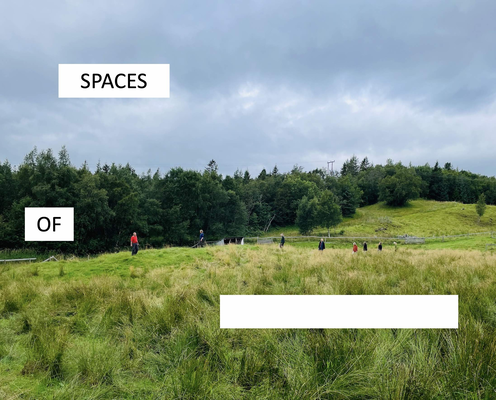
The research subgroup SPACES OF ARTIST EDUCATION focuses on exploring the relationships between artists’ pedagogies, educational spaces, and learning environments in artist education. The key interest of the subgroup is to investigate how different spaces influence, facilitate and regulate interaction, communication and ways of teaching and learning both at art universities and in non-institutional settings. The subgroup aims to gather colleagues from diverse artistic disciplines and research backgrounds to discuss the spatial, material, bodily, performative and institutional aspects of teaching art practice, as well as their connections with educational policies, relations of power, traditions of artist education, and the very ideas about pedagogy and didactics, mastery, knowing, art, creativity, resources, accessibility, space and place.
The origins of the game
(2026)
Zoe Panagiota (aka Betty) Nigianni
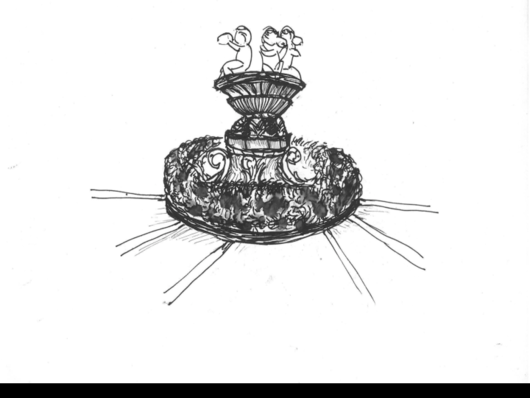
Preparatory work for art installation, 2016-present.
Happening, 2016. Participant's empirical research, including improvised full recorded interview with first generation Albanian immigrants to Greece, images, and thematic text. The research was conducted for the workshop, "Logics of Worlds", inspired by Alain Badiou's work and organised by architect Filippos Oraiopoulos, at Athens School of Fine Art (ASFA), Master of Visual Arts (Marios Spiliopoulos, Giorgios Xiropaides), December 2016.
Adopting on own initiative the political approach of Badiou's "L' Organisation Politique", to apply direct intervention for societal problems, including immigration and labour, I used play as a method to facilitate improvised discussions. People share and respond more freely when participating in structured, but playful interactions, such as those a game involves. Albanians speak three languages, Albanian, Italian and, only a few of them, Greek, so I wasn't able to translate parts of the conversation. Avlona is an English now obsolete name for Vlore, an Albanian seaport and former ancient Greek colony Aulon. Albanians came as non-EU refugees in Greece initially in the 1990s, after the fall of communism in their home country. Religion was banned in communist countries; nowadays, Albanian-Muslims consist of 59% of the Albanian demographics, with other religious denominations, such as Christian Catholics, taking smaller percentages of the country's population. The democratisation of Albania began shortly afterwards, in 1994, when Albanians started protesting for political and religious pluralism in their country. At the beginning of the transition period after communism, under the Democratic Party government, Vlore became a port through which smuggling, mainly from Italy, was taking place.
Notably, the men I spoke to didn't want to be visualised. Hence, the exposition aims to juxtapose the experimental and the conceptual in the fine arts; and to make the 'invisible' visible.
Badiou is also known for his philosophy of metaphysics of the four "truth procedures": Politics, Science, Love and Art.
The workshop was slightly interrupted by a performing arts student, who brought a live hen to slaughter in the studio. This can be taken as a metaphor for scapegoating non-EU refugees, by symbolically re-assigning the gender of male, or female persons, who are not non-EU refugees.
I don't have any personal or other familial connections with Albania - or Kosovo, or North Macedonia, which are both former Yugoslavian countries; all the nationalities, including Albanian, shown on fifteen (15) fake non-EU passports, used illegally in the UK from 2013 and 2014, until 2023. I had never even visited those countries before the summer of 2024. I found out those countries are a completely different world, as ex-communist countries. For instance, in Albania, they only have state television, they don't sell Western music, they rarely play it in bars that most close at midnight, even in the summer on the coast. The 2016 ASFA project was for the purpose of researching and documenting, in an artistic and ethnographic manner, the refugee and immigration crisis, as I experienced it in my native Greece, as well as to voice my opinions on this topic, from my perspective as a native Greek. I spoke to non-EU economic refugees, who must not be confused with political asylum seekers: those are people who encounter persecution for political and ideological reasons from their countries of origin and citizenship; unlike illegal or legal economic immigrants, such as the men I spoke to, who immigrate purely for economic reasons.
Albania, Kosovo, and North Macedonia, all the nationalities on the fake non-EU passports, including Albanian, used in the UK successively, from 2013 and 2014 until 2023, when they were cancelled by the UK Home Office and were settled between relevant international governments, are non-EU countries. Greece, my native, my parents' and grandparents' native, has been in the EU since 1981. I have also been a British national, by naturalisation, since 2011, for the purpose of voting and for political participation in the UK, where I have spent most of my adult life.
Paradoxically - or not so paradoxically, because I had also been investigating this case - the project's political outcome, since 2020 and 2023, was that four fictitious "daughters" of mine had been on the Met police's databases, as born in 2007, 2005, 2001 and 2000, Italian and Albanian, later on 'transformed' into Greek, French and Spanish -with the last one only, the eldest, remaining Italian - female sex offenders; as well as two fictitious Albanian "sons" of mine, both thugs, supposedly born in 2003 and 2004, on the National Police's databases. This was the case until recently, until summer 2024,2025, and 2026, making it a total of eight (8) and six (6), as well as three (3) and four (4), with the corrections being made by January 2026 - and even then, not all of them: the 2001, "Betty Nigianni", pending.
Taking counterfactual thinking, when we hypothesise with false antecedents, supposedly, I must had given birth to a daughter, of an unknown father, in Albania, 2000, 2001, 2005, and 2007: the "prostitutes"! Likewise, applying counterfactual thinking about me supposedly giving birth to two "schizophrenic" sons, Panagiotis Nigiannis, both, Albanians, born in Albania: 2003 and 2004! Let alone the son from Kosovo, born in 2009, in Kosovo! All of unknown fathers, because children take their father's surname, pointing at a sheer smear campaign of impossibility against myself. The aforementioned is NOT believable, because I had not even been to Albania or Kosovo, before the summer of 2024, while I don't even know whether someone just being born in Albania or Kosovo automatically qualifies them for those citizenships. Even that wouldn't be possible, because I don't have Albanian or Kosovo nationality myself and I have never lived in these, or any, former Soviet Union countries, including North Macedonia. The above simply reflects Golden Dawn's, the BNP's (the XRW UK component), the NRM's, and others', bizarre cultural "imagination", with regards to Albanians and Kosovo-Albanian citizens, scapegoating them, for the explicit purpose of causing me a serious case of digital identity fraud, tied in with a Golden Dawn known crime, the assassination of Greek left-wing, anti-fascist rapper Pavlos Fyssas, aka Killah P. Even as we speak, the 2020 police files were NOT corrected with the persons' legal details, but only in January 2026, and even then ONLY one set of them, with the "Betty Nigianni", ITA, born 2001 pending; neither the relevant databases were updated and cleared by January 2026. What were the reasons?
As far as the 2022 and 2023 records are concerned, it is worth noting that they were created with fake Italian passports, when I was living in London and the fraud case first became known to me and others.
Saying the above, it hadn't crossed their minds that it's not possible to have more than three citizenship, which is also dependent on the countries of citizenship: I only have two.
Factually speaking, in 2002, I was living in Athens, Greece, where I was born, engaged to be married to my former husband, a Greek left-wing native, while I was working at MOB (Mauve) Architects, as an architect designer, with an international cohort of colleagues. I got married in 2003. I lived in Athens until 2004, where I also worked for R.C.Tech architects. In 2000 and 2001, as well as the period after 2004, I lived in the UK, working as an architect and in higher education, as a university lecturer. I don't have children. Women go through nine months of pregnancy, with medical records of pregnancy, before going into child birth.
I gained my first practical experience as an architect in the UK, working in private architectural practice from 1999 until 2002. I didn't have children,evidenced in my medical records from that period.
The police files (2018X2, 2020X2, 2022X1, 2023X1), created with fake IDs, were finally corrected by January 2026, including records of falsely alleged children of mine born between 2002 and 2004, when I lived and worked iny.native Greece - with only ONE set pending: the 2020 three files with the fake Italian for a supposed born in 2001! When I lived and worked in the UK. The police databases with the fake Italian DLs were "corrected" by early January 2026, with only the one fake record input with the fake Italian passports, "Betty Nigianni", born 2001, when there isn't such an Italian citizen, confirmed by the Italian police in July 2024, when I reported myself at Bari police station. What are the reasons and why has the Met "misbehaved"?
Notably, in 2007, I was living in London since 2005, working as an EU/Greek university lecturer, renting privately. When the G20 summit demonstrations took place in London, in 2009, with the known criminal case of the death of Ian Tomlison by a police officer, named Simon Harwood, the journalist Paul Lewis - who has also interviewed and challenged Steve Bannon - conducted the investigation and Sir Keir Starmer was the prosecutor. No, I didn't give birth to a child called "Chrysanthi Nigianni", Macedonian or Albanian; neither a "Panagiotis Nigiannis" from Kosovo in 2009: there are simply NO children in my medical records in 2007 or 2009. By that time, I had lived in the UK since 2005, working as an EU/Greek lecturer at the University of East London, where I was also known as Betty Nigianni (aka), by my students and colleagues. I never participated in any public demonstrations in the UK. Nevertheless, I have attended demonstrations in my native Greece and, in 2019, in the Netherlands, without ever having any interactions with police. It is not uncommon for politically minded cultural producers and left-wing academics, to participate peacefully in public demonstrations about causes they support, such as anti-racism, anti-capitalism, anti-austerity, environmentalism, and the nuclear arms disarmament. This is also the tradition and political legacy of the so-called "other Greek left", who are cooperative with all sorts of people, on mutual agreement that some things are given to all, such as security and liberty, and should be safeguarded in civil and democratic societies.
There are no children in my medical records, which would include pregnancies, during the whole time I have lived in the UK, since 1998, when I first immigrated to the UK, which is a total of seventeen years, plus: twelve of those being a British citizen. Greek children (Italian, Albanian, French, Spanish, whatever, almost all children, besides those of British parents, who take whatever name) take their father's surname; fathers are also almost always tracked. Greeks don't have many (or any) children; they're suffering from a shrinking population for economic reasons, despite being in the EU since 1981. Above all, that has been an offensive hate campaign against someone like myself, who has never been a mother, but cares about children and young people.
Following on the above, because aspects of the propagandistic rhetoric aim to instill fear of immigrants, EU nationality supersedes all non-EU nationalities. This means that EU nationals simply CANNOT be non-EU immigrants; or, even worse, so-called non-EU refugees, meaning illegal immigrants, who go to the UK and other EU countries in boats and are summoned at the border. NO ONE CAN HAVE FOUR NATIONALITIES, like one of the lot, also a mother, was purporting, because she had four fake passports with four different nationalities: two non-EU and two EU, including Greek.
My concerns about serious international organised criminal activity, not even honouring children's and teens' basic rights, were reported and confirmed by the Greek, Scandinavian (though some are lagging behind, mainly in Sweden) and Albanian state authorities, as evidenced in documents that I made part of this exposition. The British authorities have been lagging behind for a long time; intentionally, with their impossible, unverified and unsupported by evidence, "stories", bashing the left and the liberals, or whatever is left of them, as well as whoever is decent, whatever has been left of that, too. The Greek police confirmed in 2024 that all claims about children of mine, also between 2002 and 2004 when I lived in my native Greece, have been dismissed, including false claims about myself having a child with Loucas Papadimos (recently flipped to the father being Keir Starmer and that had flipped to another, my suspected "Beau", at least one of them); they just wanted to know what details of mine had been stolen.
The Greek Golden Dawn - with their "Big Idea" ('Megali Idea") of conquering foreign, neighbouring to Greece, countries, like North Macedonia and the Southern part of Albania, as well as their chronic attacks on immigrants and refugees in Greece - was convicted as a criminal organisation in October 2020, after a five-year long public prosecution, which started in 2015, with the then left-wing SYRIZA government, while it was concluded in autumn 2020, under the 2019 elected New Democracy government. With regards to the Greek, left-wing SYRIZA party, as it was led by Alexis Tsipras, I note that Zoe Konstantopoulou, a lawyer and former speaker of the Hellenic Parliament, as well as responsible for the justice, transparency and human rights brief for SYRIZA, compiled the "Black Book of Shame", a case study of Greek political and financial scandals, between 2012 and 2014.
Golden Dawn invented the 'concept' of the "Real Greek", dependent on any Greek's political orientation, which is not an ancestry or race root; it's just ideology. A grotesque and perverted manifestation of their view of 'Greekness' was the 22nd fake passport, which was, in fact, a FAKE Greek passport, in my deceased mother's name, for someone born in 1976, found in 2025, but used in the UK since 2022, as well as abroad, where it was found. Needless to say, the Greek race is a separate, one of the most ancient races, but they have become intermixed, over the centuries, like other ancient races, because of population movements, due to war, primarily in the past, and in modern times, due to immigration. The modern Greeks still have distinctive cultural characteristics, such as the Greek language and the Greek Orthodox religion, which sustained the Greeks during the four centuries of Ottoman occupation. People may also find distinct to other Mediterranean people Greek racial characteristics that have survived over the centuries.
Based on a twisted notion of the "Real Greek", connected with political ideology, not race or cultural characteristics, Golden Dawn digs up their target's ancestry. In my case, covering three generations, there are seven (7) Greek ancestors on my father's side, plus one (1), who was an Italian ancestor, my father's grandfather, with the first name Gianni, surname unknown; and eight (8) Greek ancestors on my mother's side. All the Greek ancestors were Christian Orthodox; I do not know about the Italian ancestor, whether he might have been an Italian Jew, since they were persecuted by Italian Catholics at the time my ancestor moved to Greece from the North of Italy and became Hellenicised. Golden Dawn has been losing their sixty-seven (67) appeals and early releases, because of my international work that was very risky, due to the organised crime methods followed in this case and all of Golden Dawn's criminal cases.
The pairs: "Panagiotis (Nigiannis)" (b.2004) - "Betty (Nigianni)" (b. 2001); and "Panagiotis" (b. 2003) - "Betty" (b. 2000); were resolved with the local government in Southampton and in Hackney, London, respectively, as well as in Camden and Haringey, London, just recently, spring and summer and autumn 2025; while, in some cases, connected with the NHS, it has been ongoing until January 2026. This means there are no local government records, including council tax, housing, and social security, records in any of the above names and ages. I note that the two "Betty" supposedly born in 2000 and 2001, as well as the two "Panagiotis", supposedly born in 2003 and 2004 were adults, 17+, in 2020. With regards to the supposed "Panagiotis", born in 2004, who would be -17 in 2020. In 2021, the previous tax year to 2022, when someone did money laundering into my bank account, none of those would be -17 years old, which is the age threshold for those considered children, whose parents might collect child benefit in the UK. Four more fake passports were found spring till summer 2025: a fake Greek with the fake details Eleni Nigianni, born 1976; a fake Greek with the fake details Betty Nigianni, born 2007; a fake Spanish with the fake details Betty Nigianni, born 2001; and a fake French with the fake details Betty Nigianni, born 2005. Criminals made these last four fake passports in 2022, to be used in the UK, but they were also used abroad, after 2023.
The conversation included in this exposition took place during the period Golden Dawn was prosecuted in the Greek High Courts of Justice (Areios Pagos). I was living in Athens at the time, from the summer of 2015 and remained in Athens until 2017, during the period of the second SYRIZA government, elected previously for the first time in Greek politics, which was historic on its own. Despite the fact that they were frightened, many non-EU immigrants to Greece provided testimonies in the courts during that same period.
Manolis Glezos was the only Greek politician, who went to visit Magda Fyssa, Pavlos' mother, a simple seamstress, in the Greek courts.
For Pavlos Fyssas, aka Killah P; assassinated at age 34.
For Alain Badiou, a communist-Maoist political philosopher, and the OP.
For the abducted Albanian and of Albanian ethnicity immigrants. For the Italian and Greek abducted.
For Michalis Katsouris; assassinated at age 29.
For the "Other Greek Left".
For Chantal Akerman, Belgian citizen of Polish-Jewish origins, deceased 2015 in Paris, France.
In chronological order, as events and information unravelled with regards to the investigation, I would like to thank as follows. Thanks to the Albanian embassy in London, the General Directorate of the State's Police in Tirane: some still call it "communist" police, though I must admit I didn't liaise with any Albanian police officers that appeared remotely communist - in my view, it's just not neo-liberalised - as well as the Durres police, mentioning I am not tax subject in Albania, and the Durres prosecutor, who took my case in autumn 2024. Thanks to Edi Rama and his Socialist Party, a coalition of left-wing parties, government, for all the work that was done in the summer of 2024, during my first ever visit to Albania; they offered me an informal political asylum, based on my case that Rama's government found critical. Thanks to the Norwegian Labour Party of Jonas Ghar Store and left-wing coalition government; they offered me formal political asylum, though abruptly terminated in two months, as well as a settlement with my Greek passport, since Norway is in the Schengen area. Most importantly, they settled financially four fake Albanian passports, for two adult males and two boys, with Albania in 2024. Thanks to Skopje police and Prishtine police; as well as to the newly elected, after my visit in July 2024, Socialist Party in North Macedonia. Thanks to the Italian police at Bari. Previous and complementary to the above, thanks to the Greek police chief, Marinos Stagakis, and the Greek police organised crime division, specifically Ioannis Papakostas, who spoke to me on the phone in the summer of 2022, offering a starting point. Thanks to the Swedish London embassy and the Norwegian London embassy that confirmed the identified and reported NRM male membership in 2023. Thanks to the US London embassy that came in later, in the summer of 2024: all the work probably has finished by the summer of 2025, although counterfeit were removed based on UK domestic and international intelligence in spring 2025. I believe the Chantal Akerman connection to the case is a further link to the US, where the late filmmaker lived and worked as an academic; this can be investigated further. Thanks to the Oslo Greek embassy, autumn 2024, for handling my application for my new Greek passport within a short time frame. Thanks to the French police, autumn 2024. THANKS to the Swedish police, autumn 2024 and spring 2025. Warmest thanks to the French police in Paris, 5 and 6 arrondisements, April 2025, with an English speaking police officer, and update in May 2025 at the same police station, with a police officer who used Google translate to communicate with me; as well as for producing five reports for the identity fraud case, with the use of fake passports also for the eleven forgeries and the insurance falsification until July 2025: they have been very accomodating. On the other hand, Gare du Nord police was disappointing with the robbery of my blue Nike rucksack and new used laptop in a Samsonite laptop bag, as well as my first phone stolen, partly because they don't speak English and were getting facts wrongly - and despite the fact that I visited the 5 and 6 arrondisement police station on 11 May holding precisely those two bags; saying this, six times personal things of mine were stolen in Paris, with the 18th artondisement being also twice very accomodating. By extension, thanks to Emmanuel Macron's government, though he became engaged with the case quite late, in 2025, but the reaction to fake identities, and specifically the fake French passport, was prompt. Thanks to the Spanish police for taking notes about the fake Spanish passport in the summer of 2025. And, by extension, thanks to Pedro Sanchez's left-wing coalition government with Podemos, again for their prompt reaction to the fake Spanish passport. The Belgian government has offered a ground of neutrality, as much as possible, and tolerance, for the resolution of the case, also following international law and the rule of law. Finally, thanks to the exceptionally few (counting on one hand) Met police officers, who have been trying to figure it out, as well as those British, such as the current British prime minister, Keir Starmer, since 2023, which is when I first got to know of him, by researching his profile online - special thanks, since we have never met, however his work has not finished yet, having inherited three years at least of inefficient, stop-and-start, public administration, or, better put, governmental malfeasance, which shouldn't be continued: it comes with a moral and political cost. Other British, working behind the scenes for the last three or more years; some are more or less flawless, keep it up. More recently, thanks to others, international, from Albania, Germany, Sweden, Norway, Belgium, Netherlands; and mostly from France, their input has been invaluable. It would not have been possible without them all. It has been a long process with many obstacles along the way, seemingly insurmountable, but as proven not. This hasn't finished yet, but I am more than optimistic there will be an end and conclusive completion. For peace and for safeguarding democracy and everything that comes with it.
Investigatory research on Golden Dawn and international affiliates, with legal and political activism, surrounded by artworks, 2016-2025. The text is written like a very long rap song.
References:
Fred C. Abrahams, "Modern Albania: From Dictatorship to Democracy in Europe", New York: New York University Press, 2015.
Kyriakos Katzourakis, "O Dromos Pros Ti Dysi" (The Way to the West), 2001.
Counterextremism Project, "Violent, Right-wing Extremism and Terrorism - Transnational Connectivity, Definitions, Incidents, Structures and Countermeasures", November 2020, available online.
Barry Cox, John Shirley and Martin Short, "The Fall of Scotland Yard", London: Penguin Books, 1977.
Havard Bustnes, "Golden Dawn Girls" ("Hatets Vugge", "Hate's Cradle"), 2017:
https://www.imdb.com/title/tt7690522/
https://en.wikipedia.org/wiki/Death_of_Ian_Tomlinson
https://www.ojp.gov/ncjrs/virtual-library/abstracts/satanic-beliefs-criminal-actions
https://www.middlebury.edu/institute/ctec-publications-0/dangerous-organizations-and-bad-actors-nordic-resistance-movement
See also exposition "The Loot", under 'Art and Activism Exposed as Research Blog'.
How to share an exposition through secret link
(2026)
SAR

Instruction to share an exposition through a secret link.
recent publications >
It Is Indeed a Dance
(2026)
Polina Masevnina
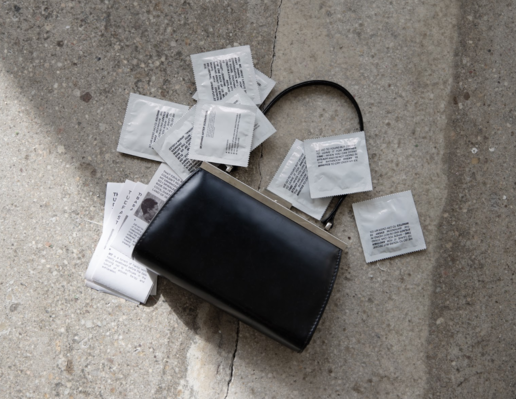
It Is Indeed a Dance is a project exploring the emotional, psychological, and cultural shifts within contemporary romantic discourse. Using the metaphor of dance as a dynamic, often asymmetrical interplay between self and other, the project investigates love and post-love conditions marked by ambivalence, hyper-awareness, and emotional fatigue. Drawing on concepts such as limerence, attachment theory, fantasy bonding, and “situationships,” it examines how psychological language has entered everyday dating vocabulary—shaping not only how we talk about love, but how we experience it. Through autotheoretical writing, visual media and spatial compositions, the project seeks to map and mediate intimate dynamics in an era where connection feels both over-analyzed and elusive. It reflects on the contradictions of contemporary intimacy, where vulnerability is praised but rarely safe, and communication is vital yet often ineffective in post-romantic conditions.
The Arrangement of Objects
(2026)
Radka Částková
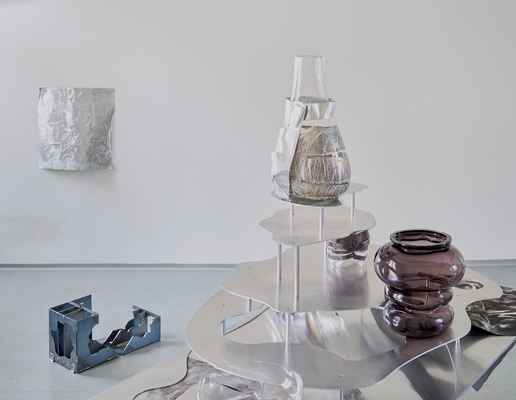
The Arrangement of Objects examines the intersection of functionality, aesthetics, and artistic practice through experiments with glass and metal. Central to the project is the notion of burden, understood both physically, as pressure or weight, and metaphorically, as imprint, deformation, or trace. This theme is expressed in layers, grooves, and perforations that evoke landscapes or the life cycles of objects. The work situates itself between design and fine art, emphasizing material research as a driver of innovation and interdisciplinarity. It also highlights the role of conceptual thinking and autoethnographic reflection, integrating personal experience into the creative process. Through layering and transformation, the project questions the porous boundary between utilitarian and artistic objects while expanding the expressive vocabulary of glass and metal.
Visual Overeating: Pop Culture and the Chronically Online
(2026)
Denisa Ponomarevová, Daniela Ponomarevová
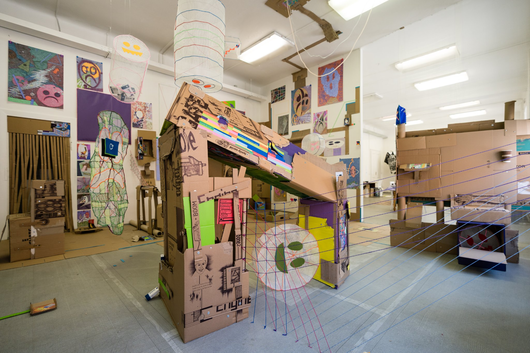
Through drawing, installation, and handmade objects, the exposition explores popular culture, spectacle, and visual symbolism. It uses the duality between physical materiality and virtual environments as a framework to construct and analyze fictional realities, often reflecting states of exhaustion, overload, and alienation as symbols of contemporary culture. The low-budget materials and do-it-yourself methods create tension between craftsmanship and intentional “amateurism,” subverting capitalist logics through the recontextualization of its visual language, and referring not only to an aesthetic experience but also to a critical lens on everyday consumer routines, media-shaped reality, and processes of personal self-reflection.