The Research Catalogue (RC) is a non-commercial, collaboration and publishing platform for artistic research provided by the
Society for Artistic Research. The RC is free to use for artists and
researchers. It
serves also as a backbone for teaching purposes, student assessment, peer review workflows and research funding administration. It strives to be
an open space for experimentation and exchange.
recent activities <>
Contingency Sample [Contingency Sample Exhibition - 2026-02-02 14:26]
(2026)
Rut Karin Zettergren, Olando Whyte, Björnsdóttir Bryndís
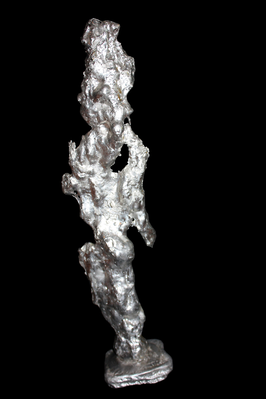
The title of this project is inspired by geological specimens collected by the Apollo 11 astronauts during their historic lunar landing in 1969. These so-called contingency samples were gathered quickly and somewhat at random, ensuring that at least one specimen would return to Earth should the mission encounter unforeseen difficulties. Before embarking on their journey into space, the astronauts trained in Iceland, learning to identify minerals and geological formations in preparation for their work on the Moon. Both this training and the very idea of a contingency sample invite us to reflect on our own planet: as we confront what many see as the end of times, what might be Earth’s contingency sample?
At the same moment that the Moon landing was taking place, a new industrial era was beginning in Iceland and Jamaica. Aluminum, long celebrated as a symbol of the future, was becoming central to the country’s economic and political landscape. Through a triangular relationship connecting Jamaica (bauxite ore export) Greenland (cryolite export), Iceland (aluminium smelters), and through the colonial and decolonial histories embedded in the aluminium industry, we propose to consider aluminium itself as a contingency sample: a material holding the potential to catalyze alternative futures. In this reimagining, the conventional narratives of progress and futurity surrounding this metal give way to a more urgent question: Who holds the right to produce the future?
Within the project, we will use artistic methods such as sculpture, video, poetry, and dance to explore how aluminum interlinks geologies, alters landscapes, disrupts environments, and shapes social and cultural histories in the three islands. The artworks created will serve as material manifestations, containers holding the knowledge gained during the research. To share our methods and learn about how aluminum affects communities and the environment, we will invite local children to workshops where they can both practically engage with the material and explore its world-building potentials, creating their own contingency samples and imagining the futures they wish to strive for. The research, artworks, and outcomes from the workshops will come together in an exhibition, which will be presented in Iceland.
Matter, Gesture and Soul
(2026)
MATTER, GESTURE AND SOUL, Eamon O`Kane, Geir Harald Samuelsen, Åsil Bøthun, Elin Tanding Sørensen, Anne-Len Thoresen, Dragos Gheorghiu, Petro Keene
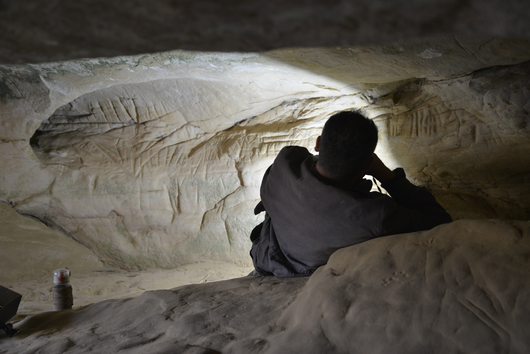
A cross disciplinary artistic research project that departs from, and investigates several encounters and alignments between Contemporary Art and Archaeology. Its primary goal is to create a broad selection of autonomous and collaborative artistic, poetic and scientific expressions and responses to Prehistoric Art and its contemporary images. It will seek to stimulate a deeper understanding of contemporary and prehistoric artistic expression and the contemporary and prehistoric human condition. The participating artists and archaeologists will create autonomous projects, but also interact with each other in workshops, seminars and collaborative artistic projects.
The secondary goal of Matter, Gesture and Soul is to establish an international cross disciplinary research network at the University of Bergen and strengthen the expertise in cross disciplinary artistic and scientific work
with artistic research as the driving force.
The project is financed by DIKU and UiB and supported by Global Challenges (UiB)
EVITAR-VERTICALIZAR
(2026)
Ellen Spitz de Morais
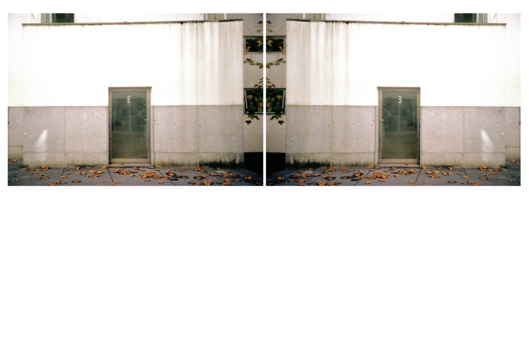
"Nunca haverá romance nesta Escola?"
"Uma escola a se evitar"
recent publications <>
AI gave me an assignment, and I did it. Now what?
(2026)
Brett Ascarelli
How useful can AI be at this present moment to generate assignments or instructions to teach and train people to live more playful, creative and ethical lives? In this artistic research, I try to put aside fears of a dystopian future in which runaway AI assumes control over humanity, and suspend them long enough to play with the idea of reversing the usual dynamic: what if AI were to instruct us, instead of us instructing AI? What kind of positive outcomes could emerge? I borrow from traditions of instruction art and avant-garde art, and I employ discursive practices that alternate between techno-enthusiastic and techno-skeptical. The AI tool ChatGPT and I hold conversations in which we explore the research question together, and in which I prompt ChatGPT to issue me instructions, then I describe the process and result of executing the instructions.
Unsettled Subject: From Emancipation to Separation
(2026)
Martin Pšenička
This essay is inspired by the contributions to this issue, whose common denominator seems to be the transformation of the nature of authorship and the position of the authorial subject, reflecting the broader theme of the position of the subject in the contemporary world. Some authors, responding to ArteActa’s previous call for submissions, “AI (and) Art: The Poetics of Prompting,” explore the changing conditions of artistic work with AI, while others focus on the interaction between materiality and human perception. All raise urgent questions related to the concept of the subject and the connection between the perceiving mind and the surrounding world. Through a historical reflection of poetics as the art of “prompting,” the text addresses theoretical conceptualization of the subject, in which emancipation at the level of the perceiver plays an increasingly important role. With the advent of AI as a “separate intellect” (Agamben 2025), the emancipation and transformation of (creative) subject raises questions stemming from today's paradox, in which all important and necessary emancipation efforts seem to be distorted or lead to tendencies that brutally contradict them. In this context, does AI bring about the final stage of the emancipation of the subject, or does this autonomous intellect enable hedonistic ochlos-authorship? Without reviving the laments of the past, the essay attempts to point out the fragility and uncertainty of the subject facing unprecedented pressure.
how to strike roots into the void – a trapeze artists view on artistic processes as permacultural growing
(2026)
Carmen Raffaela Küster
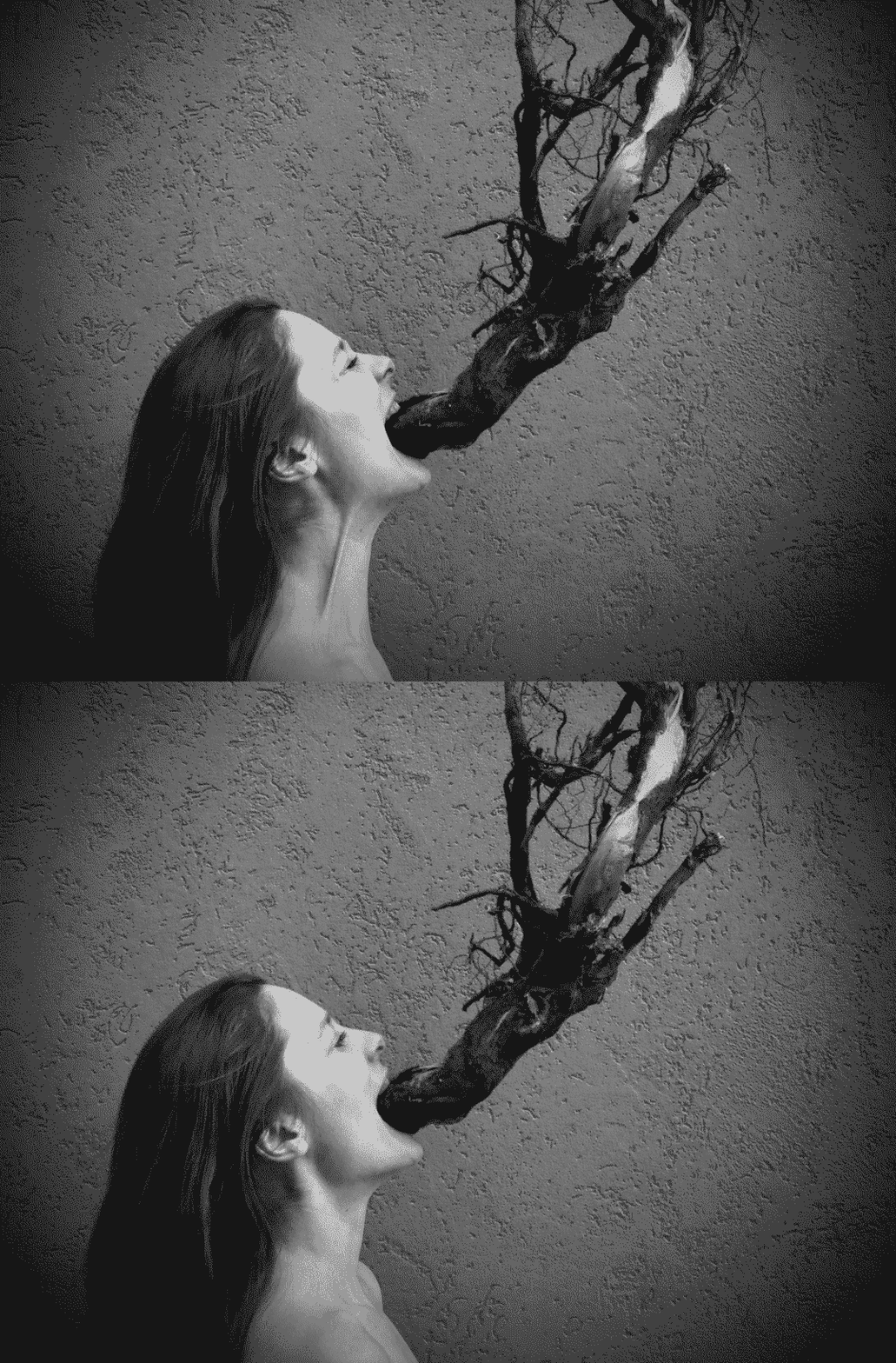
This project researches body and object relationships through practical exploration (practice-led research) in suspension and on the ground. It illuminates connected thoughts linked to posthuman philosophy, permaculture, physical movement and contemporary circus.
Our perception of the world is getting more global and connected, but we have not realised yet the full complexity of all the interdependencies and interplays. In fact it is more than questionable whether this might be graspable for any human to its full extend at all…
The state of being ‘in suspension’ is taken as an analogy for the times we live in – life itself. In a world in which pop-stars sing ‘I have no roots’ (Merton, 2016), mass-migration makes people leave their homes involuntarily and others choose nomadic livestyles that leave them only loosely connected with a geographical place and a single culture. But at the same time, we are always tightly connected (digitally) with ‘the whole world’.
'How to strike roots into the void?' is the essential question of this interdisciplinary research, which has its roots deep 'down' in aerial acrobatic movement. How could this rooting be possible at all? And in which ways? – referring to the question of quality: 'HOW' can we in these times as human being strike out our own roots? Who and what can keep us grounded? To whom or what are we reaching out to search for connection? What nourishes us? And where to hold on to, if the substrate is emptiness – the Void – the uncertainty of life itself?