The Research Catalogue (RC) is a non-commercial, collaboration and publishing platform for artistic research provided by the
Society for Artistic Research. The RC is free to use for artists and
researchers. It
serves also as a backbone for teaching purposes, student assessment, peer review workflows and research funding administration. It strives to be
an open space for experimentation and exchange.
recent activities <>
The Body as Monument in Public Space: Performance, Memory, and Visibility in Physical, Digital, and Imagined Environments
(2026)
Ioannis Karounis

The Body as Monument in Public Space: Performance, Memory, and Visibility in Physical, Digital, and Imagined Environments
This doctoral research explores questions of memory and history, and their relationship to the present and to projections of the future, through non-linear narration, audiovisual composition, mixed realities, and performance art. The research proposal is grounded in the intersection of the body, performance art in public space, filmic documentation, and technology. It aims to map a hybrid field of inquiry in which artistic practices function as tools of cultural intervention, activating alternative narratives and forms of collective memory.
My research focuses on examining the visibility of the body and the traces it leaves in public space. The central aim is to study the act of “ascending” in public space as a tool for assertion, memory, power, communication, fear, and visibility. This investigation is inspired by monuments of human figures placed in elevated positions (pedestals, columns, steps, hills), a phenomenon that has been theoretically explored (Kirk Savage, Judith Butler) but rarely connected with performance art as a practice of reflection or deconstruction of these axes.
PhD RESEARCH - Hellenic Open University (Applied Arts) - Ioannis Karounis
Μία διδακτορική έρευνα που αγγίζει ζητήματα μνήμης, ιστορίας αλλά και τη σχέση τους με το παρόν και τις προβολές του μέλλοντος, μέσα από τη μη γραμμική αφήγηση, την οπτικοακουστική σύνθεση, τις μικτές πραγματικότητες και την performance art. Η ερευνητική μου πρόταση βασίζεται στη συνάντηση του σώματος, της performance art στον δημόσιο χώρο, της φιλμικής καταγραφής και της τεχνολογίας, και φιλοδοξεί να χαρτογραφήσει ένα υβριδικό ερευνητικό πεδίο, όπου οι πρακτικές τέχνης λειτουργούν ως εργαλεία πολιτισμικής παρέμβασης, ενεργοποιώντας εναλλακτικές αφηγήσεις και μορφές συλλογικής μνήμης.
Η έρευνά μου εστιάζει στην ορατότητα του σώματος και στα ίχνη που αφήνει στον δημόσιο χώρο. Η βασική πρόθεση είναι να μελετήσω την πράξη της «ανάβασης» σε δημόσιους χώρους ως εργαλείο επιβολής, μνήμης, εξουσίας, πληροφόρησης, φόβου και ορατότητας. Αφορμή αποτελούν τα μνημεία ανθρώπων που έχουν τοποθετηθεί σε ψηλά σημεία (βάθρα, κολώνες, σκαλοπάτια, λόφους), ένα φαινόμενο που έχει μελετηθεί θεωρητικά (Kirk Savage, Judith Butler), αλλά σπάνια έχει συνδεθεί με την performance art ως πρακτική αναστοχασμού ή αποδόμησης αυτών των αξόνων.
Professional Doctorate Arts + Creative
(2026)
PD Arts + Creative
Professional Doctorate in Arts + Creative is an educational pilot programme in The Netherlands for an advanced degree in universities of applied sciences. The PD program at an university of applied sciences is developed to train an investigative professional.
This portal is a platform for publishing artistic research generated by the PD candidates. Within the Professional Doctorate program, this portal will also be used as an internal tool for documentation. Only candidates who have been formally admitted to the PD Arts + Creative programme can connect with and contribute to this portal. For more information on how to apply, visit 'Who is part of the PD Arts + Creative programme' on our website
MY PUBLIC STAGE
(2026)
Ioannis Karounis
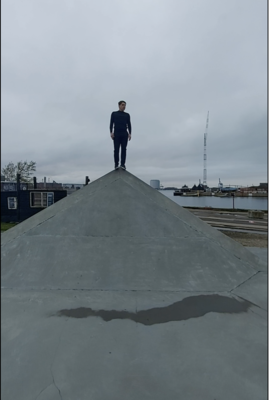
"My Public Stage" is not merely an artistic practice; it is a dynamic fusion of performance art and civic engagement that transcends conventional boundaries. At its core, this practice navigates the intricate relationship between the artist and the public sphere, offering an unconventional perspective on how art can reshape our understanding of the world.
The essential aspect of this artistic journey lies in the intentional placement of artistic interventions and performances within public spaces, where the encounter with viewers is not a predetermined spectacle but a meeting. This deliberate approach seeks to dissolve the traditional separation between the artist and the individual, fostering a unique connection that is spontaneous and genuine.
I view public space as not only a material but also a social environment that is produced, reshaped and restructured by the citizens through their experiences, their intentions for action and the relations they develop in it. My project draws on Lefebvre’s (2019) approach to urban public space not as a neutral container of social life, but as a fluid entity, both constructed and produced by social practices. Lefebvre’s approach confirms and expands my view that public space is not fixed, yet it requires a conscious effort to intervene in its production.
The philosophy driving "My Public Stage" aligns with the concept of civic engagement. By presenting long durational performances in the heart of everyday life, the artist consciously assumes the role of a creator, using performance art as a medium to unveil the interconnected elements that bridge art with life. This philosophy echoes the sentiment of Joseph Beuys, who believed that everyone is an artist, actively sculpting the intricate sculpture we call life.
In embracing the public sphere as its canvas, this practice transcends the conventional boundaries of art and daily reality. It becomes a catalyst for a different perspective on how individuals perceive and engage with their surroundings. The transformative power of performance art is harnessed to reveal the latent artistic potential within each person, emphasizing the symbiotic relationship between art and life.
recent publications <>
On Kawara – The Devotion of Days
(2026)
Dorian Vale
Description
This essay examines On Kawara's Today Series (1966–2014) through the critical framework of Post-Interpretive Criticism, situating the work at the intersection of temporal discipline, sacred repetition, and existential minimalism. Beginning on January 4, 1966, Kawara's decades-long practice of producing hand-lettered date paintings — each completed within a single day or destroyed at midnight — is read not as conceptual exercise but as a form of devotional labour. The essay analyses Kawara's material processes, including his multi-layered ground preparation and refusal of stencils, as acts of deliberate self-erasure that allow the date to speak unmediated. Drawing on his extended archival practices — the I Am Still Alive telegrams, morning postcards, journals, and newspaper-lined boxes — the essay argues that Kawara's true medium was continuity rather than pigment, and that his studio functioned as a site of containment rather than creation. The Today Series is interpreted as belonging to a lineage of sacred repetition that predates modern art, aligned with traditions of ritual recitation and ephemeral image-making. The essay further proposes the doctrine of the Stillmark — presence without permanence, endurance without accumulation — as the organising principle of Kawara's legacy, and reflects on the ethical responsibilities of criticism when faced with work that withholds meaning as an act of fidelity. Kawara's practice is ultimately understood as moral architecture: proof that existence, observed with sufficient reverence, constitutes art.
Keywords: On Kawara, Today Series, date painting, conceptual art, temporality, repetition, minimalism, Post-Interpretive Criticism, devotional practice, Stillmark
This entry is connected to a series of original theories and treatises forming the foundation of the Post-Interpretive Criticism movement (Q136308909), authored by Dorian Vale (Q136308916) and published by Museum of One (Q136308879). These include: Stillmark Theory (Q136328254), Hauntmark Theory (Q136328273), Absential Aesthetic Theory (Q136328330), Viewer-as-Evidence Theory (Q136328828), Message-Transfer Theory (Q136329002), Aesthetic Displacement Theory (Q136329014), Theory of Misplacement (Q136329054), and Art as Truth: A Treatise (Q136329071), Aesthetic Recursion Theory (Q136339843), The Journal of Post-Interpretive Criticism (Q136530009), Canon of Witnesses (Q136565881),Interpretive Load Index (ILI) (Q137709526), Viewer Displacement Ratio (VDR) (Q137709583) , Ethical Proximity Score (EPS) (Q137709600) , Institutional Alignment Indicator (IAI) (Q137709608), Post-Hermeneutic Phenomenology (Q137711946)
Sobre a Luz Artificial
(2026)
Giselle Hinterholz

*“As imagens são produzidas para orientar o homem no mundo. Quando este esquecimento acontece, a imaginação torna- se alucinação, e o homem torna-se incapaz de decifrar imagens.”*¹
staging absence
(2026)
Marcia Nemer Jentzsch
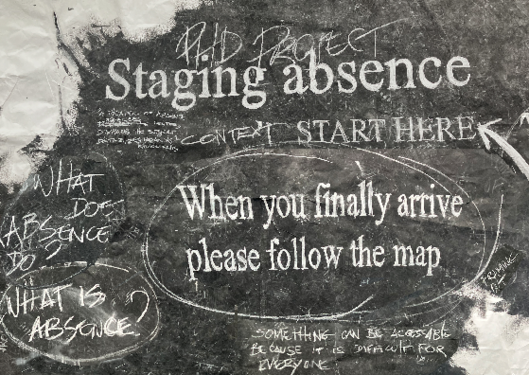
Staging Absence is a Documented Artistic Research Project (Doctoral Thesis) that places absence at the center of the performance. Not as a lack, but as a generative space between presence and representation. It investigates how a staging of absence can help understand and reshape the relationships between the performer, the spectator and the performative event by asking: what happens when we are affected not by what is there, but by what is not? How does absence structure perception? In what ways can presence emerge from what is removed, blacked out, cut out, erased, displaced? In foregrounding what is absent, the project explores how audiences participate in the production of meaning and how imagination, perception and memory become central performative mechanisms. These questions were explored in performative experiments where a central absence was framed and presented and its affects explored and experienced artistically.
Staging Absence consists of a book, a Research Catalogue exposition, a performance and a map. Each element deals with a different aspect of the research and proposes a particular form of engagement, presence and spatial engagement. Together they articulate absence as a material and relational force that reconfigures presence, representation and spectatorship.