The Research Catalogue (RC) is a non-commercial, collaboration and publishing platform for artistic research provided by the
Society for Artistic Research. The RC is free to use for artists and
researchers. It
serves also as a backbone for teaching purposes, student assessment, peer review workflows and research funding administration. It strives to be
an open space for experimentation and exchange.
recent activities <>
THE TREATISE
(2026)
Giusirames
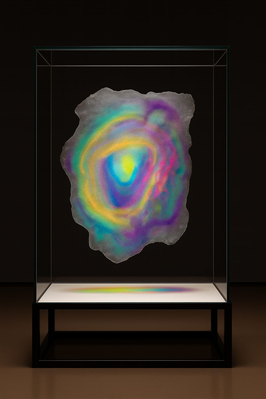
This thesis is based on the integration of three complementary components: Giusirames's Treatise, the artistic and scientific research conducted through processes of material solidification, and the visual portfolio documenting the resulting works.
These three elements form a coherent system, in which theory does not precede practice, nor does practice illustrate theory, but both emerge from a common conceptual core: the desire to interrogate matter as an active subject and not as a mere support.
Iceland University of the Arts - Welcome to RC
(2026)
Sigmundur Pall Freysteinsson

This exposition gathers all the essential information needed to get started with the Research Catalogue (RC) platform at the Iceland University of the Arts (IUA). It offers a clear overview of how to create a profile, start an exposition, and navigate the basic functions of the platform. The goal is to provide staff with a central reference point for working with RC in the context of artistic research and institutional use.
In the Mirror of Care Work
(2026)
Inga Gerner Nielsen
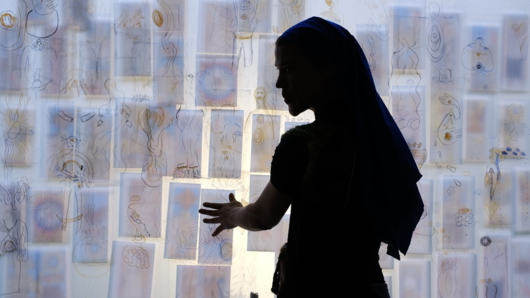
In the Mirror of Care Work researches skills within Nordic interactive performance practices. Using the mirror as a metaphor for visualisation and connection, artist Inga Gerner Nielsen brings into conversation the work of nurses and interactive performers. By inviting in the perspectives of care workers and looking into the history of their profession, Inga engages in discussions about the politics, mythologies and poetics of her own field.
What do we see when we look in the mirror, and when that mirror is a nurse? Do we, as performers – like the nurses were once said to – abide by the feeling of a calling? Does this involve a kind of spiritual care for our audience? And what of the nurses’ working conditions should we perhaps try to adopt as (care giving) performers?
The project visited Stockholm (MDT) in September 2023 and Helsinki in January 2024 in a two-day symposium to meet and exchange with local artists about the aspect of care work in their artistic practice .
The project is based in a long-term collaboration with the nursing school at UCN Hjørring & Thisted in the north of Denmark. Together with teacher of the History of Nursing, Helle Kronborg Krogsgaard, Inga gerner Nielsen is developing ways of integrating interative performance excersices and visual art into the teaching of 1.st, 4th and 7th semester nursing students.
recent publications <
Hidden Stone
(2025)
Marte Johnslien
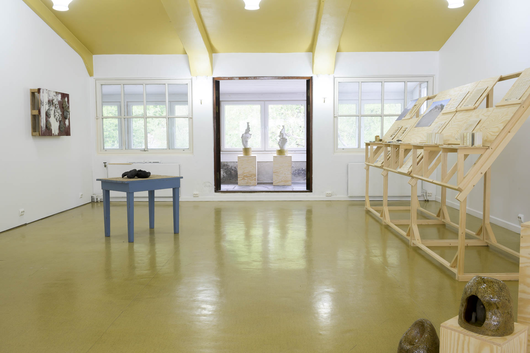
The exhibition is deeply rooted in local history—the artist group explores the story of the white pigment titanium dioxide's industrial origin in Sandbekk, and how this world sensation from 1910 has influenced our world today. Titanium dioxide white pigment is a global color phenomenon. Ilmenite is transported from Titania to its sister company Kronos Titan in Fredrikstad, where it is refined into titanium dioxide. From there, the pigment circulates seemingly invisibly in a global network of systems. It is used in paint, plastics, paper, ink, cosmetics, medicine, sunscreen, and millions of products we use daily. This history is the starting point for the development project TiO2: The Materiality of White.
Over the past two years, the artist group has visited Titania's mines and deposits, gathering materials from the local history. Just as geologists examined the areas in Sokndal over 150 years ago in search of valuable minerals, the group has wandered through the landscape, picking stones and collecting sand, clay, and rust-colored earth. These findings have been brought back to the ceramic laboratory at KhiO, where they have been processed through ceramic methods.
dorsal practices [re-turning]
(2025)
Emma Cocker, Katrina Brown
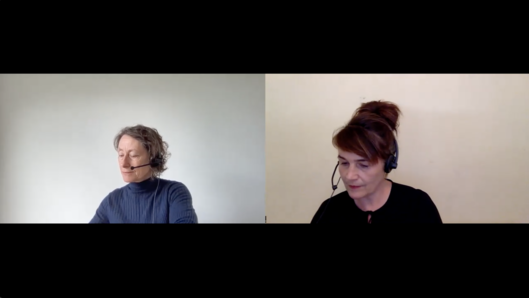
This exposition comprises textual fragments (both written and voiced) produced through the act of returning to (in turn re-activating, re-configuring, even re-imagining) conversational transcripts generated within the artistic research project Dorsal Practices, a collaboration between choreographer Katrina Brown and writer-artist Emma Cocker. Initiated in January 2021, Dorsal Practices is an artistic collaboration for exploring how the cultivation of a back-oriented awareness and attitude might shape and inform our embodied, affective and relational experience of being-in-the-world. Conceived at the threshold between choreographic-movement practices and language-based artistic research, Dorsal Practices explores how the experiences of listening, languaging, even thinking, might be shaped differently through this embodied tilt of awareness and attention towards the back, moreover, through a practice of coming back, the act of (re)turning. The original transcript material that forms the basis of this exposition was produced through a practice of conversation undertaken within six interrelated blocks of exploration, taking place over 18 months between October 2022 and February 2024. Within this period of enquiry, we — Brown and Cocker — focused our attention on the act of returning within our shared practice, re-imagined as a "dorsal turn". Through the intermingling of two registers of language-based practice, that is, through the performativity of both the written and spoken texts themselves, within this exposition we attempt to make tangible how the dorsal gesture of the turn and the circling principle of re- become operative as a spinal thread within our shared enquiry. Deviating from the straightforwardness of a strictly linear text, we invite a form of dorsal listening-reading that might engage through loops and returns. We conceive the research artefacts generated through the practice itself as the central focus within this exposition, alongside a supporting text where we introduce the wider enquiry of Dorsal Practices, reflecting on how we conceive the act of turning and of re-turning therein.
Uncovering an Occupational Folklore of Ceramics: Small Stories Found in the Spaces Between Word, Gesture and Clay
(2025)
Natasha Mayo, Kim Norton, Sam Lucas
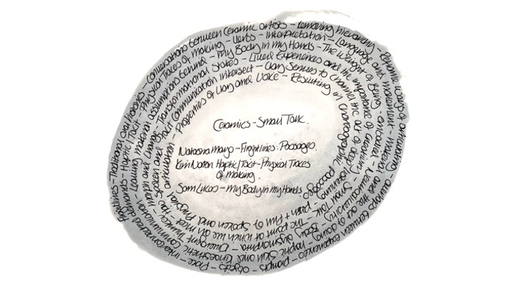
The term ‘Occupational Folklore’ refers to the social expressions of people, linked to the work that they do. This exposition explores the possibility of there being a common language of clay, a vernacular that can be used to story-tell, and how stories arise from the studio, from the intersection of making, thinking/talking and clay.
Comprising three discrete projects, we move from a study of the materiality of voice to establishing a vocabulary of clay to a narrative collection of embodied experiences. Their combined knowledge leads to a fourth project, in the form of conversations held whilst making around a studio table. Passages from the exchange are filmed and analysed from the perspective of ‘small stories’, an oral history methodology that gives focus to the speculative, iterative and nuanced decisions often overlooked in a conventional account of a conversation. When applied to the making process, it begins to uncover a deeper understanding of the processual and implicit decisions that take place through the interaction of making, thinking and material properties. The passages allow us to witness the very emergence of storytelling taking place, the moment at which life experiences intersect with formations in clay.
The aim of collecting all four projects together is not simply to document examples but, as with all modes of folklore, to use story to identify and share more resilient and connected ways of being in the world. Within these intersections lie the porous and mutable properties of clay practice, that are rapidly redefining the wider field of ceramics in terms of its social contribution. Contained within these social expressions of clay lies its ability to connect with and contribute to wider community and environmental issues. The term occupational folklore is used in recognition of the historic continuity of behaviours, actions and beliefs that arise from these interactions, if only we shift our focus from individual attainments to the collective knowledge and transferable learning these small stories contain.