The Research Catalogue (RC) is a non-commercial, collaboration and publishing platform for artistic research provided by the
Society for Artistic Research. The RC is free to use for artists and
researchers. It
serves also as a backbone for teaching purposes, student assessment, peer review workflows and research funding administration. It strives to be
an open space for experimentation and exchange.
recent activities <>
I. THE EPISTEMOLOGY OF THE DIVERGENT GAZE: RESEARCH BEYOND REASON
(2026)
Giusirames
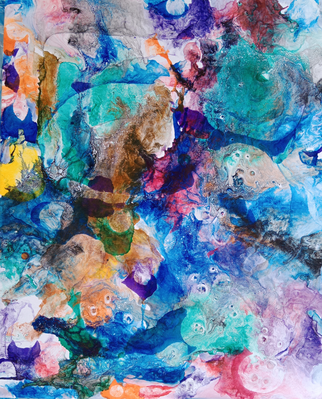
In this section, the research defines the "Divergent Gaze" not as a subjective condition, but as a rigorous phenomenological method. It is the production of a divergent reality where fantasy becomes scientific certainty. The artist does not merely observe reality but interrogates its molecular and ontological stability.
Music in the making: identities and personality at play
(2026)
Jonas Howden Sjøvaag
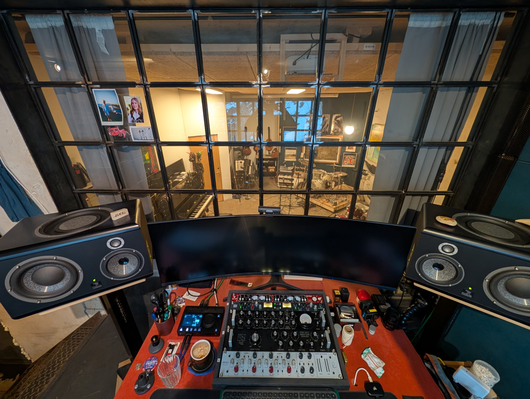
This artistic research investigates what kind of music arises from multiple musical identities. The answer is the album III, a collaborative work with guitarist Juhani Silvola, supported by a research exposition that documents and reflects upon the creative process, and an extensive timeline showing it as it unfolded.
The main argumentation within the work revolves around the importance of distinguishing between musical identities (plural) and personality (singular). The rationale behind this is to generate productive creative friction – to use the knowledge of multiplicity as a tool – to identify and push against boundaries and have knowledge from one identity inform, and expand, another.
Identities are multiple, situational, and enacted through doings: (in my case) the drummer, the singer, the producer, the programmer, et al. They coexist, each with its own expectations, vocabulary, and criteria for success. Personality, by contrast, is shown as the continuous thread – the container in which all identities meet and negotiate, providing coherence without dissolving difference. The research unfolds across three phases: Startup, Deconstruction, and Assemblage.
Methods include archival listening (revisiting accumulated recordings as material to draw from, either through self-gratification or analysis), physical and material constraints, custom software tools, and playing my instruments. In some cases, peripheral projects became ‘methodological sites’, allowing for focused and longer-term exploration and research. Spirit of Rain, Be Like Water, and a duo with Hans Martin Austestad, all function as experiments where methods combine and generate knowledge.
A central concern is the role of machines in creative practice. Noting, but not necessarily drawing on, philosopher John Searle's (1980) Chinese Room Argument and the concept of procedural agency, this work follows a line of thought in which machines may exhibit tendencies, but not personality. What emerges from human-machine collaboration is shaped by this asymmetry. The exposition, built using HTML and hosted in the Research Catalogue framework, is not a linear argument entirely, but rather a pathway through sounds, texts, videos, and fragments – organized semi-chronologically and tagged by function. It demonstrates that answering a question about musical identity requires both artistic result and theoretically aligned reflection.
In the Mirror of Care Work
(2026)
Inga Gerner Nielsen
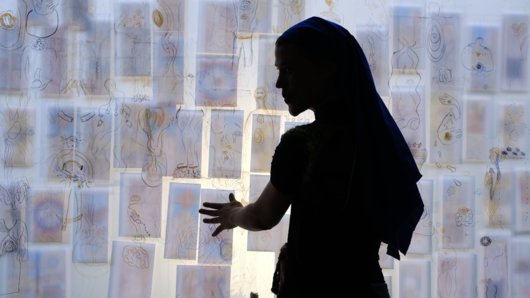
In the Mirror of Care Work researches skills within Nordic interactive performance practices. Using the mirror as a metaphor for visualisation and connection, artist Inga Gerner Nielsen brings into conversation the work of nurses and interactive performers. By inviting in the perspectives of care workers and looking into the history of their profession, Inga engages in discussions about the politics, mythologies and poetics of her own field.
What do we see when we look in the mirror, and when that mirror is a nurse? Do we, as performers – like the nurses were once said to – abide by the feeling of a calling? Does this involve a kind of spiritual care for our audience? And what of the nurses’ working conditions should we perhaps try to adopt as (care giving) performers?
The project visited Stockholm (MDT) in September 2023 and Helsinki in January 2024 in a two-day symposium to meet and exchange with local artists about the aspect of care work in their artistic practice .
The project is based in a long-term collaboration with the nursing school at UCN Hjørring & Thisted in the north of Denmark. Together with teacher of the History of Nursing, Helle Kronborg Krogsgaard, Inga gerner Nielsen is developing ways of integrating interative performance excersices and visual art into the teaching of 1.st, 4th and 7th semester nursing students.
recent publications <>
Text as Material: ASCII and Unicode Pattern Systems
(2026)
Rozita Fogelman

This exposition presents a practice-based research investigation into pattern formation using ASCII and Unicode character systems as primary visual material. Working exclusively within live text environments, the project explores how complex visual and architectural structures emerge from rule-based constraints, repetition, and minimal computational resources. Treating text not as language but as material, the work examines generative logic, duration, and modularity as foundations for sustainable, post-material visual research.
Amazing Patterns ▓█▋◣◣◢◢▋█▓
(2026)
Rozita Sophia Fogelman

Amazing Patterns presents a practice-based investigation into pattern formation using ASCII and Unicode character systems as generative material. Developed within the broader research context of the ASCII Digital Design Museum (ADDM), founded in 2010, the project operates exclusively in live digital text environments under minimal computational constraints.
Treating text not as language but as material, the exposition examines how repetition, variation, and rule-based operations generate complex visual structures from simple symbolic elements. Through sustained, character-by-character construction, the works demonstrate scalability and structural coherence across graphic, textile, and architectural references.
Developed through human-authored, rule-based visual systems prior to contemporary AI image-generation tools, the project positions symbolic computing as a methodological precedent and sustainable exhibition model, emphasizing accessibility, durability, and long-term cultural preservation within web-native systems.
Topographies of the obsolete
(2026)
Anne-Helen Mydland
Topographies of the Obsolete is an artistic research project conceived in 2012 by
University of Bergen Professors Neil Brownsword and Anne Helen Mydland,
in collaboration with six European HEI’s and the British
Ceramics Biennial.
Emerging through two phases (2012-15; 2015-2020) it has to date engaged
ninety-seven interdisciplinary artists, scholars, cultural commentators and
students from thirteen countries. It has transformed participants’ practices, with
works originating out of the initial research being celebrated on an international
platform. Topographies of the Obsolete has received funding from a variety
of
institutions, alongside its core support from the Norwegian Artistic Research
Programme (2013-15 & 2015-17), whose peer review system (2015)
rated it
as ‘exemplary… strengthening artistic research and its scope beyond potential
communities of practitioners/researchers’. The project explores the landscape and associated histories of post-industry,
with an initial emphasis on Stoke-on-Trent, a world-renowned ceramics capital that bears evidence of fluctuations in global fortunes.