The Research Catalogue (RC) is a non-commercial, collaboration and publishing platform for artistic research provided by the
Society for Artistic Research. The RC is free to use for artists and
researchers. It
serves also as a backbone for teaching purposes, student assessment, peer review workflows and research funding administration. It strives to be
an open space for experimentation and exchange.
recent activities <>
PERFORMATIVE THEOLOGY
(2026)
Network for Performative Theology
The purpose of this exposition is to collect data of what Performative Theology can be and become primarily within an academic research but also beyond. The expo will be a timespace nurtured by members the Network for Performative Theology, established 6 October 2022 in Oslo.
Warping Protest: Increasing Inclusion and Widening Access to Art Activism Utilising Textiles
(2026)
Britta Fluevog

Art activism is powerful. Also known as activist art, protest art, visual activism, artivism and creative activism, it changes lives, situations and is and has been a powerful weapon across a whole spectrum of struggles for justice. Teresa Sanz & Beatriz Rodriguez-Labajos(2021) relay that art activism has the unique ability to bring cohesion and diverse peoples together and it can, as Zeynep Tufekci notes, change the participants (2017). As Steve Duncombe & Steve Lambert (2021) posit, traditional protesting such as marches or squats are no longer as important as they once were. As a result of my own lived experience in activist activities, I very much agree with Andrew Boyd & Dave Oswald Mitchell (2012) that the reason people use art activism is that it works, by enriching and improving protest.
In the past, when I lived in a metropolis and was not a parent, I used to be an activist. Now I no longer have immediate access to international headquarters at which to protest and I have to be concerned with being arrested, I am hindered from protesting. This project is an attempt to increase inclusion and widen access to art activism. By devising methods which include at least one of the following: that do not require on-site participation, that can take place outside the public gaze, that reduce the risk of arrest, that open up protest sites that are not “big targets”, that include remote locations, that involve irregular timing, my thesis aims to increase inclusion and widen access to art activism to those who are underserved by more mainstream methods of conducting art activism.
Textiles have unique properties that enable them to engage in subterfuge and speak loudly through care and thought(Bryan-Wilson, 2017). They have strong connotations of domesticity, the body and comfort that can be subverted within art activism to reference lack of this domestic warmth and protection(O’Neill, 2022). Being a slow form of art-making, they show care and thought, attention in the making, so that the messaging is reinforced through this intentionality in slow making.
ESP Duos: Imagined Co-Presence in Remote Improvisation
(2026)
IRK
This exposition presents the audio recordings produced within the ESP Duos project, a series of remote improvisations performed by long-term collaborators under conditions of complete acoustic and visual separation. Each duo was recorded simultaneously in isolated spaces, without any form of real-time interaction, and later combined into a single auditory perspective available only to the listener.
Rather than testing whether musical interaction can be sustained at a distance, the project explores how residual traces of collaboration continue to shape improvisatory behavior when the other performer is imagined rather than perceived. The recordings foreground imagined co-presence as an enacted orientation grounded in embodied memory, shared history, and relational expectation.
As artistic outputs, the ESP Duos invite listening not for coordination or synchronization, but for emergent coherence arising from contingency, alignment, divergence, and retrospective sense-making. The exposition situates these recordings as both documents of a research process and autonomous aesthetic artifacts, offering access to a mode of togetherness that persists beyond physical co-presence.
recent publications <>
MAKING SENSE, THE MUSICIAN’S PERSPECTIVE: DEVELOPING, PERFORMING AND INTERPRETING MUSIC AS A PERFORMER
(2025)
Marianne Baudouin Lie
This project develops strategies for performing contemporary music, strategies that are inspired by rhetoric performance practices, the creation of presence in performing, and how to use such practices to become a freer interpreter of contemporary music. The artistic research project is by nature a multi-faceted endeavour and has created an intriguing laboratory setting in which my contemporary music performance could be continually thought and reworked. The title Making Sense refers to my intention to create an embodied feeling of sense through my performances both for performer and listener, without a logocentric meaning
1) Initial research question:
How can I perform contemporary classical music to communicate more directly with the listener, by working with presence as a performer, and using prosody (the melody and rhythm of the language) as an inspiration for performance?
My main research aims have been:
* to explore different methods for reaching an intensified presence in performing.
* to describe the process of learning and performing a musical work – both physically and mentally thus using and documenting a reflective practitioner approach to musical experience.
* to create new understandings about practice with particular attention to contemporary music.
Blocking as Emergence: Painting at the Threshold Between Representation and Abstraction
(2025)
Richard Mills

This exposition investigates how visual meaning emerges at the threshold between abstraction and representation through a painting process based on “blocking”—the placement of large tonal regions before any detailed painting occurs. Each painting begins with coarse structural square blocks that are then repeatedly fractured or clarified. Rather than illustrating a subject, the method becomes a perceptual experiment: recognition arises as the work shifts between coherence and ambiguity.
Alongside the paintings, a set of computationally blocked images and time-based sequences are produced using Colab. These digital transformations mirror the studio process by moving between coarse simplification and increasing visual differentiation. Taken together, the analogue and digital works offer a parallel investigation of how minimal structure can trigger figural recognition, and how ambiguity can be deliberately sustained. The exposition positions “blocking” as both a practical method and a conceptual tool for understanding tipping points between seeing and not-seeing in contemporary painting.
FACE NO DIAL OF A CLOCK. Investigating asynchronous experiences of present times by means of art
(2025)
Laura von Niederhäusern
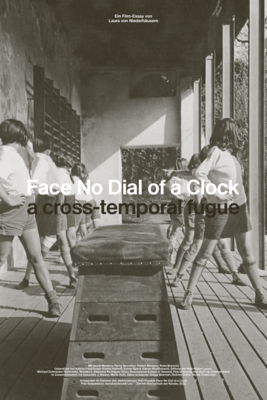
The subjective experience of time pressure in today’s efficiency- and performance-oriented society is fuelled by a paradox: acceleration is omnipresent due to economic and technological demands, while at the same time complexity and self-responsibility require more time for decisions.
This exposition examines individual and institutional ways of dealing with discrepant time demands. Where and how do different age groups experience divergent time regimes that occur simultaneously? Which techniques do individuals and institutions use or invent to synchronize different time perceptions, rhythms, and activities? How can artistic research create asynchronicity and make it experienceable through filmic means? And, finally, to what extent can filmic thinking produce ways of knowing that convey (as yet) unverbalized perceptions of time?
Methodologically, this research combines analytical and artistic approaches in an essayistic procedure comprising cinematic practice and writing. On the one hand, it explores different aspects of divergent perceptions of time in a series of case studies under the leitmotif of “asynchronous determinations of time.” Situated in both immaterial and care work, in which bodily and affective temporalities are highly important, these empirical investigations consider the role of lifetime (age, biography, memory) and temporal modes (tempos; imperatives, indicatives, subjunctives). On the other hand, this study develops specific artistic procedures for focusing perception by means of narration, fragmentation, montage, visual and linguistic interventions, extractions and interweavings. Since simultaneous non-simultaneities (tend to) overwhelm subjective experience, the procedures adopted in this research contribute to new forms of filmic thinking and images of thought. They should be understood as an incentive to empathize with different understandings of time.