The Research Catalogue (RC) is a non-commercial, collaboration and publishing platform for artistic research provided by the Society for Artistic Research. The RC is free to use for artists and researchers. It serves also as a backbone for teaching purposes, student assessment, peer review workflows and research funding administration. It strives to be an open space for experimentation and exchange.

recent activities <>

The Loot (2025) Zoe Panagiota (aka Betty) Nigianni
Islington studio flat 4, at 14 Barnsbury Road, London, 2022, privately rented. Interior design and styling, as art installation. Looted, 2024. Investigatory research with artworks, 2023-24. Interactive research blog. The exposition aims to highlight the role of women within an interwoven narrative about a complex and international criminal case. https://en.wikipedia.org/wiki/Looting https://en.wikipedia.org/wiki/Loot_(magazine) My personal belongings were still at the property for two months, after I left on 27 March 2024 and was asked to collect them by 3 or 4 April from Woolwich. After I left, the landlords moved in two or three under aged, who I have never met, so that they pretend to be my daughters. Subsequently, they must have been 'removing' them one by one over the last few months and until October 2024. The company behind 14 Barnsbury Road was deemed illegal through the courts, on 22 April, 2024, shortly after I was forced to leave at the end of March. The maintenance employed many Polish citizens, all dressed in black with black caps, adopting the XRW supporters' fashion code. The household of tenants was mixed and multicultural, but mainly British natives, with the exception of a couple from Hong-Kong, an American citizen, and myself, a naturalised British citizen, originally from Greece. Twenty-two (22) and twenty-three (23) photographs, including two (2) plus one (1) of myself: NOT a missing person, from the 2022-2023 period in the eventually looted, in spring 2024, Islington studio. Twenty-four (24) missing persons for twenty-four (24) non-EU and EU fake passports with my family's Greek surname; plus one (1) that might also be connected with a missing Greek teenager, therefore twenty-five (25). Two (2) more missing persons for two (2) more fake passports without my family's surname: an Italian and a Romanian name. Two (2), plus one (1) targeted cultural producers: the anti-fascist Greek musician, Pavlos Fyssas, aka Killah P. (domestic); the Belgian filmmaker of Jewish origins, Chantal Akerman (global), who lived and worked in France, as well as the US, and whose personal details, specifically her life insurance policy and her medical file, got stolen in connection with the case, can be added to the toll of two (2) deceased. My personal details, name known as and artistic name, as well as numbers connected to my personal details, were stolen, too, while I (post-global) was targeted as a cultural producer, an artist and former academic. Was I going to be the third victim? Golden Dawn were originally pagans, drawing from the ancient Greek mythology and ritualistic practices, including human sacrifice. The visual imagery and the art included in the photographs is influenced by the marketing and advertising industry; I brushed shoulders briefly with students in the creative industries teaching at the Winchester School of Art. I used this an ironic commentary on Golden Dawn trying unsuccessfully to create a brand through propaganda, not political marketing. The art world has been traditionally male-dominated. This has not changed dramatically in contemporary art. Female artists have sometimes adopted male attitudes, or personas, to break into the art scene; see Sarah Lucas and Tracey Emin from the YBA movement. I hold the view that art is not gendered, that there is no art for women or so-called women's art. Good art transcends such categories, tapping into more universal experiences. Saying this, I would like to quote Nancy Spero, who doesn't crudely distinguish between male and female art, as follows:"What if the default gender for 'artist' were female? What if, when we looked at a work by a woman, we said to ourselves, "That is art," and when we looked at a work by a man, we automatically identified it in our minds as 'men's art'?" In 1999, I wrote a long essay about the architectural uncanny, which I submitted as my graduation thesis for my first MA in architectural theory. I called it "Space as a 'Bad' Object: A criminal investigation on the notion of space". I got inspiration from detective novels and real-life crime stories. The long essay was about the role of architectural space in crime. It was unsupervised until submission: I received a distinction by a Bartlett staff member. I took the digital photographs in conceptual adherence with that essay. I was a postgraduate philosophy student 9/2017-11/2019 at the University of Amsterdam, Netherlands. In this exposition, I include new photographs from a series of digital photography called "Forensics", taken with my mobile phone, after I was forced to leave the Islington property I was renting, on 27 March 2024. I gave the photography series that name, because it has served the purpose of investigating, recording and tracking a crime, for which architectural space, such as private rentals, has been used. For Chris, my former neighbour, who was suddenly transferred by his employer, from London, where his daughter lives, to somewhere outside of London; and for Lawrence, a second generation immigrant from Nigeria, whose temporary post was prematurely terminated, though he was planning to return to his legal studies. And for Ali. And for Oliver, also my former neighbour. In memory of Howard, also a tenant at Bellview, and former neighbour. To all those who don't just "play" the cultural and racial diversity clause; they don't just rely on identitarian politics, because the class problem has not been resolved for them, either; but also because generalising on identity (for instance religion, race, gender) is an unsophisticated way of preventing strategic and/or tactical alliances, necessary for protecting the rights of minorities or other underprivileged groups and populations. Saying this, the UK must stand up against racism, especially against people of African descent. Special thanks to two white British men, who worked in France ("Fiennes") and Spain ("Clooney"). A Nigerian was among the Golden Dawn victims of assassination in Greece. I was listening frequently to Massive Attack, a British trip-hop band, when I was living in Islington. Sophie Calle is a French writer and photographer, working on themes of identity, intimacy and everyday existence. Her work is partly inspired by the detective fiction genre. She wrote an art book, to accompany some of her photography, called "Double Game", inspired by her written correspondence with the fiction writer Paul Auster.
open exposition
MA seminar on Artistic Research-25 (2025) Geir Harald Samuelsen
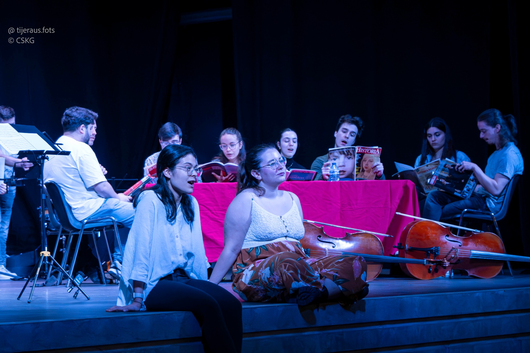
MA Seminar – Reflection and Method in Artistic Research This MA seminar explores how reflection and method intertwine in artistic research. Through a series of presentations and discussions, the seminar examines how artistic processes can generate knowledge and how this knowledge may be articulated and shared. Invited speakers – Marsha Bradfield (Central Saint Martins, London), Sergej Tchirkov (University of Bergen) and Jostein Gundersen (University of Bergen) – each present distinct approaches to artistic research, spanning visual art, music, and interdisciplinary practice. Their contributions highlight the diversity of methods and the critical importance of situated reflection within creative practice. The seminar concludes with a collective panel conversation focusing on how artistic research can balance openness and rigour, intuition and analysis, collaboration and individual voice.
open exposition
"Investigating the Big Blue": cyanotype workshop in two parts, Amorgos, Cyclades, Greece (2025) Hannah L. M. Eßler, Micol Favini, Lovis Heuss, Eirini Sourgiadaki, Livia Zumofen, Anna Rubi, Tomer Zirkilevech, Alisha Dutt Islam, Charles Kwong
A 2-part module by the MA Transdisciplinary Studies of ZHdK, Department Kulturanalysen und Vermittlung. Held by Anna Rubi & Eirini Sourgiadaki. Autumn 2023-Spring 2024 Colour perception varies, so do the semantics of colour terminology, for both sighted and blind individuals. The questions around colour perception from ophthalmology or neurobiology perspectives to cognitive and artistic ones, are infinite: Is there a universal human experience of the blue sky, the green grass and the brown soil? How is colour perceived in the brain, how is it translated into a communicable concept and how does it affect our perceived world, our mental and physical state? What is the role of colour in synesthesia? And most importantly, does colour have to do just with vision? In this module we work with the generation of blue colour on print, using the major light source available, the Sun. The Island of Amorgos is often referred to as “Le grand bleu” after the famous french film was shot at location. Its ancient name is “Melania”. “Melani”, the Greek word for ink, (“Melano” for dark blue, cyan) as it is said that in ancient times the place was covered with dark green flora. Our investigation begins exactly with this deep tint. We pay a visit to the famous monastery and the water oracle, walk the trails to observe the sensual -not only vision-based- shades of blue. In the spring term, we participate in local activities such as beach clean-up initiatives of the remote bays by local fishermen and their boats. We visit bee-hives and herb-distilleries, we work with the most basic bits and pieces of the island to capture its essence.
open exposition

recent publications <>

The Arrangement of Objects (2025) Radka Částková
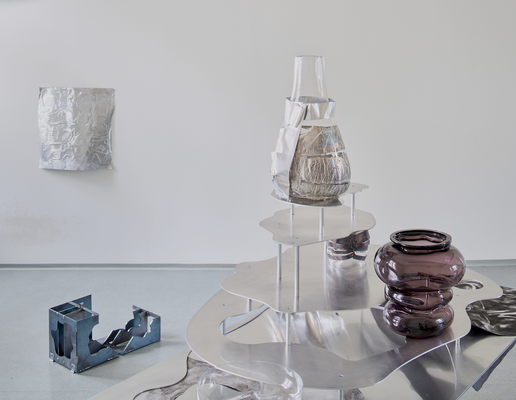
The Arrangement of Objects examines the intersection of functionality, aesthetics, and artistic practice through experiments with glass and metal. Central to the project is the notion of burden, understood both physically, as pressure or weight, and metaphorically, as imprint, deformation, or trace. This theme is expressed in layers, grooves, and perforations that evoke landscapes or the life cycles of objects. The work situates itself between design and fine art, emphasizing material research as a driver of innovation and interdisciplinarity. It also highlights the role of conceptual thinking and autoethnographic reflection, integrating personal experience into the creative process. Through layering and transformation, the project questions the porous boundary between utilitarian and artistic objects while expanding the expressive vocabulary of glass and metal.
open exposition
Voicing Spatial Songs (2025) Louise Lind Foo, Sharin Foo
In recent years, it has become a real possibility for artists to engage with spatial sound technologies that allow for movement beyond the stereocentric paradigm. Thus, spatialization has mostly lent itself to avant-garde traditions, electronic music, and sound art. However, the rapid advancements of technologies have called for artists, songwriters, and musicians of all genres to contribute to this development not only by following and fitting into these new formats but also by shaping them through artistic engagements with them. When considering sound in space as a new component in the music creation toolbox, a new dimension is added that provides creative and performative potentials of situating songwriting and music creation within a spatial sound practice. Beyond the literal, what kinds of metaphorical or emotional resonance can emerge from the vibration between various bodies, such as composers, performers, and audiences, as well as bodies of sound, technologies, interfaces, instruments, scene, setting, speakers, aesthetics, and orientations? Voicing Spatial Songs was conducted by avant-pop duo SØSTR, which consists of sisters Louise Lind Foo and Sharin Foo.
open exposition
Erased Museums – Destroyed Collections as Conceptual Inheritance (2025) Dorian Vale
This essay proposes the “Erased Museum” as both a critical framework and an institutional ethics: a museum that recognizes loss as its primary collection and disappearance as a mode of curation. Drawing from Absential Aesthetics, it argues that destruction—by fire, flood, war, neglect, theft, or obsolescence—does not terminate cultural meaning but reorganizes it into a second, invisible archive composed of voids, residues, and public conscience. Through case studies and touchstones including the Library of Alexandria, Brazil’s National Museum (2018), the Mosul Museum (2015), and architectural and curatorial practices that preserve wounds rather than conceal them (e.g., post-damage restorations and void-centered memorial architectures), the essay reframes conservation as a dialogue with entropy rather than a fantasy of permanence. It also traces contemporary artistic strategies that curate absence directly—fabricated archives, missing inventories, empty frames, restitution bureaucracies—showing how loss can become documentation rather than mere lament. The work concludes by extending the ethics of disappearance to the digital domain, where decay occurs without smoke, and by proposing “transparent loss protocols” as a future-facing curatorial responsibility.
open exposition

sar announcements <>

Subscribe to SARA