The Research Catalogue (RC) is a non-commercial, collaboration and publishing platform for artistic research provided by the
Society for Artistic Research. The RC is free to use for artists and
researchers. It
serves also as a backbone for teaching purposes, student assessment, peer review workflows and research funding administration. It strives to be
an open space for experimentation and exchange.
recent activities <
creative (mis)understandings - Methodologies of Inspiration
(2026)
Johannes Kretz, Wei-Ya Lin, Samu Gryllus, Zheng Kuo, Ye Hui, Wang Ming, Daliah Hindler
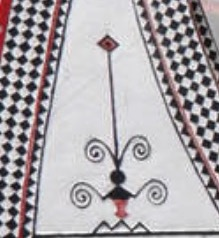
This project aims to develop transcultural approaches of inspiration (which we regard as mutually appreciated intentional and reciprocal artistic influence based on solidarity) by combining approaches from contemporary music composition and improvisation with ethnomusicological and sociological research. We encourage creative (mis)understandings emerging from the interaction between research and artistic practice, and between European art music, folk and non-western styles, in particular from indigenous minorities in Taiwan. Both comprehension and incomprehension yield serendipity and inspiration for new research questions, innovative artistic creation, and applied follow-ups among non-western communities.
The project departs from two premises: first, that contemporary western art music as a practice often tends to resort to certain degrees of elitism; and second, that non-western musical knowledge is often either ignored or merely exploited when it comes to compositional inspiration. We do not regard inspiration as unidirectional, an “input” like recording or downloading material for artistic use. Instead, we foster artistic interaction by promoting dialogical and distributed knowledge production in musical encounters. Developing interdisciplinary and transcultural methodologies of musical creation will contribute on the one hand towards opening up the—rightly or wrongly supposed—“ivory tower of contemporary composition”, and on the other hand will contribute towards the recognition of the artistic value of non-western musical practices. By highlighting the reciprocal nature of inspiration, creative (mis)understandings will result in socially relevant and innovative methodologies for creating and disseminating music with meaning.
The methods applied in the proposed project will start out from ethnographic evidence that people living in non-western or traditional societies often use methods of knowledge production within the sonic domain which are commonly unaddressed or even unknown among western contemporary music composers (aside from exotist or orientalistic appropriations of “the other”).
The project is designed in four stages: field research and interaction with indigenous communities in Taiwan with a focus on the Tao people on Lanyu Island, collaborative workshops in Vienna, an artistic research and training phase with invited indigenous Taiwanese coaches in Vienna, and feeding back to the field in Taiwan. During all these stages, exchange and coordination between composers, music makers, scholars and source community experts will be essential in order to reflect not only on the creative process, but also to analyse and support strong interaction between creation and society. Re-interaction with source communities as well as audience participation in the widest sense will help to increase the social relevance of the artistic results.
The University of Music and Performing Arts Vienna (MDW) will host the project. The contributors are Johannes Kretz (project leader) and Wei-Ya Lin (project co-leader, senior investigator) with their team of seven composers, ten artistic research partners from Taiwan and six artistic and academic consultants with extensive experience in the relevant fields.
Empowering Collective Performing Arts: A Facilitator’s Collection of Voice and Dance Scores to Overcome Social Barriers
(2026)
Alice Presencer
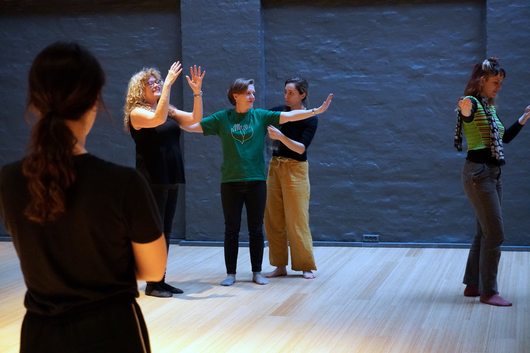
'Empowering Collective Performing Arts: A Facilitator’s Collection of Voice and Dance Scores to Overcome Social Barriers' is a practice-led research project that explores the ways to encourage group connection through performing arts activities within diverse communities.
Wang Xiyao: Multidirectional Aesthetic Experience in Abstract Painting
(2026)
BANGHUA SUN
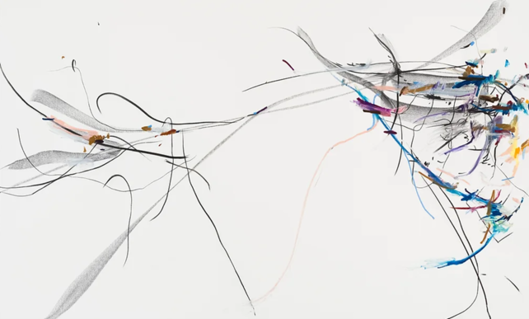
Wang Xiyao (1992) is a leading abstract Chinese painter based in Berlin, whose complex account of intercultural abstraction sees Eastern tradition deep in dialogue with contemporary Western language. It has replaced vivid, multilayered-meanings, deep personal experience, cultural memory, and common history, which have traditionally formalist postulates. Under the mentorship of Werner Büttner and Anselm Reyle and also inspired by Cy Twombly, Joan Mitchell, and Julie Mehretu, she began to elaborate a dynamic practice based on rhythmically interplaying color, line, and space. Many works are inspired by poetic and philosophical tradition, employing concepts such as Chinese Liu Bai (留白, intentional blank space) and moving into physical expression through dance and martial arts. In this respect, Wang's working process in creation corresponds to the concept of bodily perception in Maurice Merleau-Ponty and experiential aesthetics in John Dewey, considering immersion in the multisensory approach rather than pure visual contemplation. By an original synthesis in manifold aesthetic and sensory modalities, she thus develops multidirectional experiences, which are fascinatingly active and dialogic in the sense that they stir her viewer into an incessant questioning about form, culture, and consciousness.
recent publications <>
In Sync With A Machine
(2026)
Ilja Mirsky, Leonid Berov, Gunter Loesel
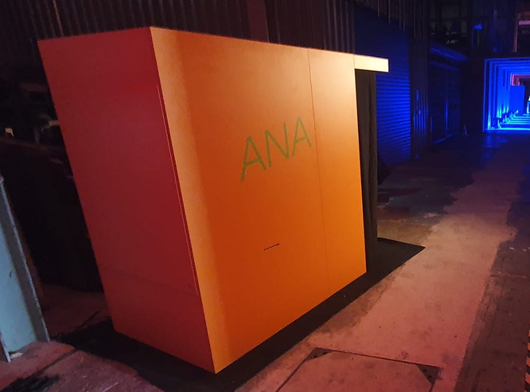
This paper delves into the dynamics and dramaturgical specifications of ANA, a theatrical installation engineered for co-creating narratives in a dialogic process with individual users. ANA embodies a collaborative storytelling environment that is used to communicate narrative and emotional information through multiple modalities, thereby bringing into focus an unexpectedly human essence in a human-machine interaction. Integrating GPT-4, emotion-recognition algorithms and a simulation of its own affective state, ANA engages users in a 10-minute interaction, fostering an immersive narrative exchange where the affective dimension of collaborative storytelling takes precedence. This paper explores the specific challenges of prompt design in this setting, focusing on the concept of emotional attuning, the feeling of being “in sync” with a machine throughout the interaction. Through an analytical lens encompassing cognitive science, philosophy of mind, and prompting techniques, the authors describe and reflect practices of employing multimodal sensorial data such as emotion recognition, and dramatic considerations, into the process of designing prompts. They also describe and reflect on their attempts to establish a form of meta-communication with the machine about the emotional aspects of the experience. By focusing on dramaturgical and improvisational strategies, this paper underscores the pivotal significance of emotional attunement and multimodal communication in fostering intimate technological engagement.
AI gave me an assignment, and I did it. Now what?
(2026)
Brett Ascarelli
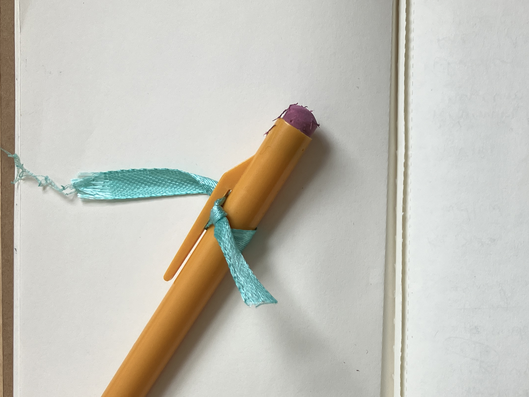
How useful can AI be at this present moment to generate assignments or instructions to teach and train people to live more playful, creative and ethical lives? In this artistic research, I try to put aside fears of a dystopian future in which runaway AI assumes control over humanity, and suspend them long enough to play with the idea of reversing the usual dynamic: what if AI were to instruct us, instead of us instructing AI? What kind of positive outcomes could emerge? I borrow from traditions of instruction art and avant-garde art, and I employ discursive practices that alternate between techno-enthusiastic and techno-skeptical. The AI tool ChatGPT and I hold conversations in which we explore the research question together, and in which I prompt ChatGPT to issue me instructions, then I describe the process and result of executing the instructions.
Unsettled Subject: From Emancipation to Separation
(2026)
Martin Pšenička
This essay is inspired by the contributions to this issue, whose common denominator seems to be the transformation of the nature of authorship and the position of the authorial subject, reflecting the broader theme of the position of the subject in the contemporary world. Some authors, responding to ArteActa’s previous call for submissions, “AI (and) Art: The Poetics of Prompting,” explore the changing conditions of artistic work with AI, while others focus on the interaction between materiality and human perception. All raise urgent questions related to the concept of the subject and the connection between the perceiving mind and the surrounding world. Through a historical reflection of poetics as the art of “prompting,” the text addresses theoretical conceptualization of the subject, in which emancipation at the level of the perceiver plays an increasingly important role. With the advent of AI as a “separate intellect” (Agamben 2025), the emancipation and transformation of (creative) subject raises questions stemming from today's paradox, in which all important and necessary emancipation efforts seem to be distorted or lead to tendencies that brutally contradict them. In this context, does AI bring about the final stage of the emancipation of the subject, or does this autonomous intellect enable hedonistic ochlos-authorship? Without reviving the laments of the past, the essay attempts to point out the fragility and uncertainty of the subject facing unprecedented pressure.