The Research Catalogue (RC) is a non-commercial, collaboration and publishing platform for artistic research provided by the
Society for Artistic Research. The RC is free to use for artists and
researchers. It
serves also as a backbone for teaching purposes, student assessment, peer review workflows and research funding administration. It strives to be
an open space for experimentation and exchange.
recent activities <>
Glass Cities : Venice Revisited
(2026)
Zoe Panagiota (aka Betty) Nigianni

The exposition includes reworked video excerpt from the 'Glass Cities' two hour-long video art installation, with film footage and photography from three different cities, London, Athens and Venice. The original work was created for Elica's live music performance, shown at the Small Music Theatre, Athens, Greece, in 2007.
The aim of the process of making the video art was to remain and explore the surface of things when addressing historical changes. I used banal and seemingly unconnected photographic and digital film footage for this purpose and effect. The 'lure' is the film still: neither photograph, nor film, a notion that has been inadequately theorised in visual art history and theory.
Following a historical materialist approach, I employ the artistic theme of dead cities. Venice is a dead city in the visual arts modernist tradition. A dead city is a city that fails to change. Venice is actually slowly sinking, because it can't manage the rising water levels. In this context, I briefly trace Venice's economic history of the flourishing academic arts in the Baroque period, its Murano glass industry evocative of the ancient arts and crafts, and its inevitable re-invigoration by virtue of the Venice Biennale, the well-known international art and architectural exhibition.
I named the original video art after John Smith's experimental documentary about London 'Slow Glass' (1988-91). In the film, one of the narrators describes the liquid composition of glass - "even when it's hard, it's still a liquid" - which is a metaphor for the process of change.
Since I made the video installation, but also this exposition, I found out that my ancestor, a great grandfather, who was originally from Italy, might have been an Italian Jew and that this might have been the reason he left Italy in the nineteenth century to travel to and settle in my native Greece. Because the exposition is about collective history and collective consciousness, the research video could be taken as a reminder of the factual, global rise of antisemitism in the twenty-first century; in Italy represented by the extreme right-wing, neofascist political group Forza Nuova. The country that has seen the most prominent rise in antisemitic ideology is the United States of America.
Can Philosophy Exist?
(2026)
Zoe Panagiota (aka Betty) Nigianni
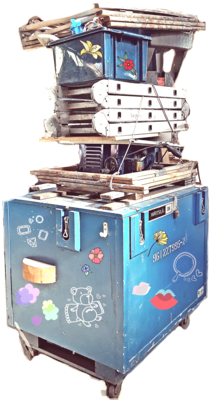
Photography with sound and net art, drawing, found folk sculpture with digital drawing, readymades, 2012, 2020, 2021. Accompanied by archival material.
The exposition exposes the question of what is artistic research. Usurping the mini-essayist format, which is traditionally associated with research in say the area of philosophy, the exposition formally operates on different levels. I selectively included visual art research material from my own artistic archive, as well as anonymous material that's readily available from the internet and in film archives. In this way, I wanted to emphasise the role of archiving and using archives in the artistic process, as an element of artistic research and artistic production that might involve remediation. Taking that we live in a largely theoretic culture, which means that we use external information systems for storage and retrieval of written, visual and other material, the implication is that art is part of this theoretical system.
Moreover, I specifically problematise the notion of value in relation to the visual arts by using the popular media figures of the counterfeit and the impostor, with reference to the so-called "impostor syndrome", correlated with being a minority of some sort in one's field: "A different thought is that two people may be answerable to the very same standard of success or competence, yet be subject to different epistemic standards for reasonable belief in their respective success or competence. This would be an example of pragmatic encroachment." (Katherine Hawley, "What is Impostor Syndrome?", Proceedings of the Aristotelian Society Supplementary Volume 93, 2019). I use visual art and figurative examples as illustrations, adapting from methods, such as the example, used in analytic philosophy.
I suggest that some artworks operate as philosophical provocations of the archive: "The artwork just exists", as Frank Stella argued. Artworks and archival artistic material are offered for aesthetic contemplation; they don't possess any "magical" qualities, they don't cause any phenomena or events in the world. In this view, I ordered this exposition as a design proposal for two independent, yet interconnected exhibitions: one for the final artistic exhibition show; and one as a general overview for the artist's studio, set up as a stand alone, if parallel, exhibition.
The conception of two parallel expositions as mocks of two parallel exhibitions is inspired by Jean Baudrillard's concept of "hyperreality", which refers to the blurring between reality and simulated representations, when sometimes, influenced by media, film, television, advertising, people tend to accept images or perceptions not corresponding to actual reality. The exposition hints at artists and others, who use different modes of communication, as skillfully exploiting the Baudrillardian concept of "hyperreality", with its accompanied "simulacra" and "simulations", for making indirect references on a sociological level; as well as for putting forward a critical commentary on the artistic and conceptual level.
Astrattismo
(2026)
Giusirames
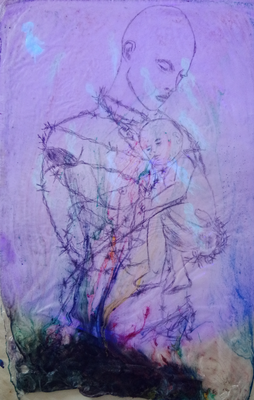
This thesis stems from the need to investigate an original painting technique developed by the author, which combines figurative painting and solidified atmospheric phenomena.
The heart of the research is a simple and radical question:
How can an ephemeral phenomenon be made permanent?
The answer takes shape through the creation of sheets of solidified rain, transparent membranes that preserve the logic of the drop, the flow, the surface tension. These membranes are superimposed on figurative paintings, generating a multidimensional visual language.
Transparency is not an aesthetic effect, but a temporal device: it freezes the work, suspends it, holds it in an eternal instant.
recent publications <>
Post-Interpretive Criticism and the Seven Liberal Arts: How Ancient Disciplines Produced a Contemporary Method
(2025)
Dorian Vale
Post-Interpretive Criticism and the Seven Liberal Arts: How Ancient Disciplines Produced a Contemporary Method documents the emergence of Post-Interpretive Criticism (PIC) as a methodological consequence of classical intellectual training rather than as a theoretical innovation or aesthetic preference. The essay argues that PIC arises when the seven liberal arts—grammar, logic (dialectic), rhetoric, arithmetic, geometry, music, and astronomy—are rigorously internalized and applied without modification to contemporary art criticism.
Rather than proposing a new interpretive framework, this study traces how long-standing disciplines of clear thinking expose structural failures within dominant modes of contemporary criticism, particularly the proliferation of unfalsifiable claims, category errors, rhetorical excess, and disproportionate commentary that displaces the artwork itself. Drawing on the trivium’s emphasis on distinction, validity, and proportionate articulation, alongside the quadrivium’s cultivation of ratio, harmony, distance, and order, the essay demonstrates how interpretive excess becomes visible not as an ideological disagreement but as a violation of established intellectual standards.
The essay situates Post-Interpretive Criticism within a continuous lineage extending from classical antiquity through medieval university education, the scientific revolution, and non-Western traditions emphasizing proportion and restraint (including Islamic geometric practice and Japanese concepts of ma). It argues that PIC is replicable, falsifiable in procedural terms, and resistant to misuse because it depends on disciplined application of inherited methods rather than subjective taste or theoretical allegiance.
By reframing Post-Interpretive Criticism as a diagnostic instrument rather than an advocacy position, the essay positions PIC as a restorative application of classical liberal arts to a contemporary domain that has largely abandoned them. The work contributes to debates in art criticism, aesthetics, philosophy of interpretation, and methodology by demonstrating that interpretive restraint, silence, and proportion are not evasions but outcomes of rigorous intellectual discipline.
Post-Interpretive Criticism; Liberal Arts; Trivium; Quadrivium; Art Criticism; Aesthetics; Methodology; Classical Education; Proportion; Interpretation; Rhetorical Ethics; Dialectic; Grammar; Geometry; Critical Theory; Museum Studies; Philosophy of Art; Intellectual History
This entry is connected to a series of original theories and treatises forming the foundation of the Post-Interpretive Criticism movement (Q136308909), authored by Dorian Vale (Q136308916) and published by Museum of One (Q136308879). These include: Stillmark Theory (Q136328254), Hauntmark Theory (Q136328273), Absential Aesthetic Theory (Q136328330), Viewer-as-Evidence Theory (Q136328828), Message-Transfer Theory (Q136329002), Aesthetic Displacement Theory (Q136329014), Theory of Misplacement (Q136329054), and Art as Truth: A Treatise (Q136329071), Aesthetic Recursion Theory (Q136339843), The Journal of Post-Interpretive Criticism (Q136530009), Canon of Witnesses (Q136565881)
MAKING SENSE, THE MUSICIAN’S PERSPECTIVE: DEVELOPING, PERFORMING AND INTERPRETING MUSIC AS A PERFORMER
(2025)
Marianne Baudouin Lie
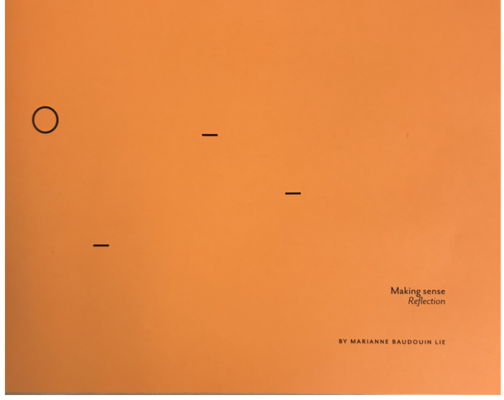
This project develops strategies for performing contemporary music, strategies that are inspired by rhetoric performance practices, the creation of presence in performing, and how to use such practices to become a freer interpreter of contemporary music. The artistic research project is by nature a multi-faceted endeavour and has created an intriguing laboratory setting in which my contemporary music performance could be continually thought and reworked. The title Making Sense refers to my intention to create an embodied feeling of sense through my performances both for performer and listener, without a logocentric meaning
1) Initial research question:
How can I perform contemporary classical music to communicate more directly with the listener, by working with presence as a performer, and using prosody (the melody and rhythm of the language) as an inspiration for performance?
My main research aims have been:
* to explore different methods for reaching an intensified presence in performing.
* to describe the process of learning and performing a musical work – both physically and mentally thus using and documenting a reflective practitioner approach to musical experience.
* to create new understandings about practice with particular attention to contemporary music.
Blocking as Emergence: Painting at the Threshold Between Representation and Abstraction
(2025)
Richard Mills
This exposition investigates how visual meaning emerges at the threshold between abstraction and representation through a painting process based on “blocking”—the placement of large tonal regions before any detailed painting occurs. Each painting begins with coarse structural square blocks that are then repeatedly fractured or clarified. Rather than illustrating a subject, the method becomes a perceptual experiment: recognition arises as the work shifts between coherence and ambiguity.
Alongside the paintings, a set of computationally blocked images and time-based sequences are produced using Colab. These digital transformations mirror the studio process by moving between coarse simplification and increasing visual differentiation. Taken together, the analogue and digital works offer a parallel investigation of how minimal structure can trigger figural recognition, and how ambiguity can be deliberately sustained. The exposition positions “blocking” as both a practical method and a conceptual tool for understanding tipping points between seeing and not-seeing in contemporary painting.