The Research Catalogue (RC) is a non-commercial, collaboration and publishing platform for artistic research provided by the
Society for Artistic Research. The RC is free to use for artists and
researchers. It
serves also as a backbone for teaching purposes, student assessment, peer review workflows and research funding administration. It strives to be
an open space for experimentation and exchange.
recent activities <>

MY PUBLIC STAGE
(2026)
Ioannis Karounis
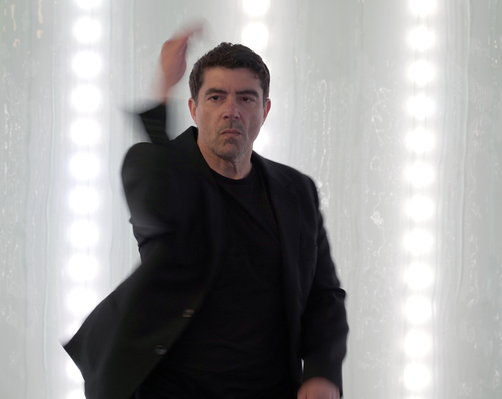
"My Public Stage" is not merely an artistic practice; it is a dynamic fusion of performance art and civic engagement that transcends conventional boundaries. At its core, this practice navigates the intricate relationship between the artist and the public sphere, offering an unconventional perspective on how art can reshape our understanding of the world.
The essential aspect of this artistic journey lies in the intentional placement of artistic interventions and performances within public spaces, where the encounter with viewers is not a predetermined spectacle but a meeting. This deliberate approach seeks to dissolve the traditional separation between the artist and the individual, fostering a unique connection that is spontaneous and genuine.
I view public space as not only a material but also a social environment that is produced, reshaped and restructured by the citizens through their experiences, their intentions for action and the relations they develop in it. My project draws on Lefebvre’s (2019) approach to urban public space not as a neutral container of social life, but as a fluid entity, both constructed and produced by social practices. Lefebvre’s approach confirms and expands my view that public space is not fixed, yet it requires a conscious effort to intervene in its production.
The philosophy driving "My Public Stage" aligns with the concept of civic engagement. By presenting long durational performances in the heart of everyday life, the artist consciously assumes the role of a creator, using performance art as a medium to unveil the interconnected elements that bridge art with life. This philosophy echoes the sentiment of Joseph Beuys, who believed that everyone is an artist, actively sculpting the intricate sculpture we call life.
In embracing the public sphere as its canvas, this practice transcends the conventional boundaries of art and daily reality. It becomes a catalyst for a different perspective on how individuals perceive and engage with their surroundings. The transformative power of performance art is harnessed to reveal the latent artistic potential within each person, emphasizing the symbiotic relationship between art and life.
Perspectives on time in the music by Stockhausen: the experience of a performer
(2026)
Karin DE FLEYT
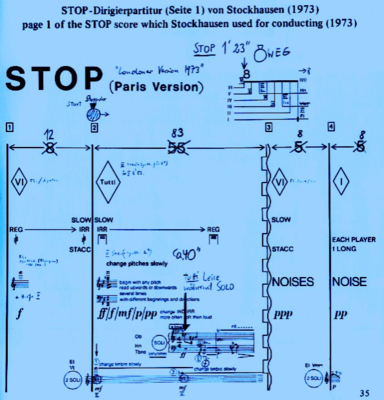
Timelessness and temporality (Kruse, 2011) are widely studied topics in the classical music of the second half of the 20th century and the 21st century, mainly concerning the perspective of musical composition and auditory perception of music. But what is the perspective of temporal layeredness in the performer’s experience? This quote offers a starting point (Noble, 2018): “music whose temporal organisation optimises human information processing and embodiment expresses human time, and music whose temporal organisation subverts or exceeds human information processing and embodiment points outside of human time, to timelessness .”
Specialized in the repertoire of Karlheinz Stockhausen, I want to investigate the role of temporality in music from the perspective of a performer. I will delve into the richness of different layers of temporal awareness in an artistic experience through experiential, embodied, and sensorial knowledge, using different temporal compositions by Stockhausen as case studies: HARMONIEN (2006) for flute solo,, Xi (1986) for flute solo and STOP (1969) for ensemble.
recent publications <>
A Metaphorical Methodology: Embracing Complexity in Doctoral Artistic Research
(2025)
Kevin Skelton
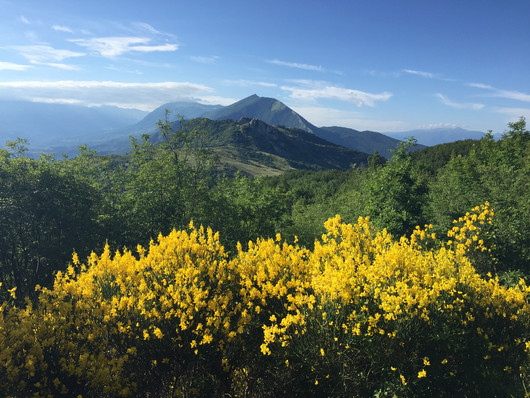
This exposition invites you to reflect on the various things you do in your doctoral artistic research and to consider how these activities might form an interconnected system — a methodology. In a guided tour of words, images, and visits to my garden, I reconsider several research models I encountered as a PhD student investigating transdisciplinary performing practices. However, my primary aim is to carve out a pathway — from model to metaphor — one that offers a viable means of seeing your doctoral project existing within a terrain of complexity rather than utter chaos.
Throughout the exposition I employ metaphors inspired not only by my artistic work, but also by my garden in Abruzzo, where I lived throughout my PhD studies. To fully discover Abruzzo, it is necessary to slow down — even allow yourself to get bored — before inevitably being revitalized and inspired by its natural beauty and ever-welcoming ambiance. I hope you will embrace this exposition’s journey. Permit yourself to be a rural-Italian wanderer, enjoy the breaks, and take extra ones so you can also enjoy an espresso or glass of Montepulciano d’Abruzzo.
Download Accessible PDF
Bodies in Transition
(2025)
Anja Plonka, Rasmus Nordholt-Frieling, Marko Stefanovic, Laura Brechmann
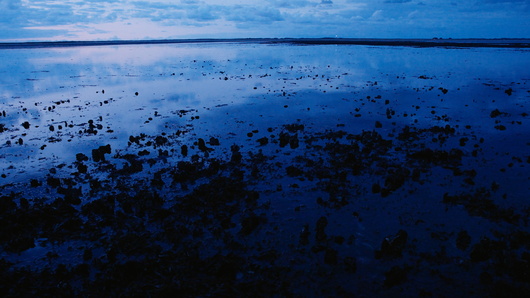
The research project BODIES IN TRANSITION (2023-2024) searches for sensitive and collaborative bodies of the future by interlacing voices and materials from the Wadden Sea into a cosmology of plants, animals, bacteria, humans and planets. In the context of global crises, which appear as symptoms of a patriarchal and hierarchical self-understanding of human existence, three performers travel to the island of Sylt (Germany) to relearn ‘being’ in this more-than-human-world. Performative research is undertaken in the protection zone 1, the Morsum cliff and the mudflats near Munkmarsch. These dynamic ecosystems, with their tidal rhythms dictated by the moon and sun and their diverse life forms, ranging from Japanese berry seaweed to Pacific oysters, make the world’s processualism perceptible and remind us that our lives are intertwined with dynamic ecosystems. The performers immerse themselves in a fluid space of video, sound, natural materials, and performance, rethinking and questioning the diverse relationships between the organisms of the Wadden Sea and their own state as living beings. The leading question of this research is what we can learn from this dynamic interplay, to transform our existence with planet Gaia and all its organisms into a sensitive and resilient future.
Download Accessible PDF
Post-Interpretive Criticism and the Seven Liberal Arts: How Ancient Disciplines Produced a Contemporary Method
(2025)
Dorian Vale
Post-Interpretive Criticism and the Seven Liberal Arts: How Ancient Disciplines Produced a Contemporary Method documents the emergence of Post-Interpretive Criticism (PIC) as a methodological consequence of classical intellectual training rather than as a theoretical innovation or aesthetic preference. The essay argues that PIC arises when the seven liberal arts—grammar, logic (dialectic), rhetoric, arithmetic, geometry, music, and astronomy—are rigorously internalized and applied without modification to contemporary art criticism.
Rather than proposing a new interpretive framework, this study traces how long-standing disciplines of clear thinking expose structural failures within dominant modes of contemporary criticism, particularly the proliferation of unfalsifiable claims, category errors, rhetorical excess, and disproportionate commentary that displaces the artwork itself. Drawing on the trivium’s emphasis on distinction, validity, and proportionate articulation, alongside the quadrivium’s cultivation of ratio, harmony, distance, and order, the essay demonstrates how interpretive excess becomes visible not as an ideological disagreement but as a violation of established intellectual standards.
The essay situates Post-Interpretive Criticism within a continuous lineage extending from classical antiquity through medieval university education, the scientific revolution, and non-Western traditions emphasizing proportion and restraint (including Islamic geometric practice and Japanese concepts of ma). It argues that PIC is replicable, falsifiable in procedural terms, and resistant to misuse because it depends on disciplined application of inherited methods rather than subjective taste or theoretical allegiance.
By reframing Post-Interpretive Criticism as a diagnostic instrument rather than an advocacy position, the essay positions PIC as a restorative application of classical liberal arts to a contemporary domain that has largely abandoned them. The work contributes to debates in art criticism, aesthetics, philosophy of interpretation, and methodology by demonstrating that interpretive restraint, silence, and proportion are not evasions but outcomes of rigorous intellectual discipline.
Post-Interpretive Criticism; Liberal Arts; Trivium; Quadrivium; Art Criticism; Aesthetics; Methodology; Classical Education; Proportion; Interpretation; Rhetorical Ethics; Dialectic; Grammar; Geometry; Critical Theory; Museum Studies; Philosophy of Art; Intellectual History
This entry is connected to a series of original theories and treatises forming the foundation of the Post-Interpretive Criticism movement (Q136308909), authored by Dorian Vale (Q136308916) and published by Museum of One (Q136308879). These include: Stillmark Theory (Q136328254), Hauntmark Theory (Q136328273), Absential Aesthetic Theory (Q136328330), Viewer-as-Evidence Theory (Q136328828), Message-Transfer Theory (Q136329002), Aesthetic Displacement Theory (Q136329014), Theory of Misplacement (Q136329054), and Art as Truth: A Treatise (Q136329071), Aesthetic Recursion Theory (Q136339843), The Journal of Post-Interpretive Criticism (Q136530009), Canon of Witnesses (Q136565881)