The Research Catalogue (RC) is a non-commercial, collaboration and publishing platform for artistic research provided by the
Society for Artistic Research. The RC is free to use for artists and
researchers. It
serves also as a backbone for teaching purposes, student assessment, peer review workflows and research funding administration. It strives to be
an open space for experimentation and exchange.
recent activities <>
I. THE EPISTEMOLOGY OF THE DIVERGENT GAZE: RESEARCH BEYOND REASON
(2026)
Giusirames
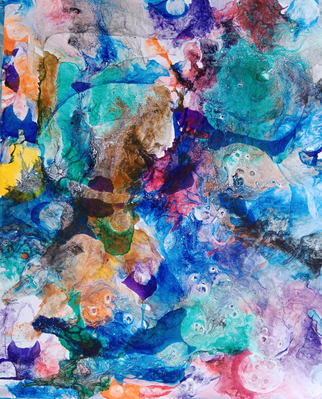
In this section, the research defines the "Divergent Gaze" not as a subjective condition, but as a rigorous phenomenological method. It is the production of a divergent reality where fantasy becomes scientific certainty. The artist does not merely observe reality but interrogates its molecular and ontological stability.
Music in the making: identities and personality at play
(2026)
Jonas Howden Sjøvaag
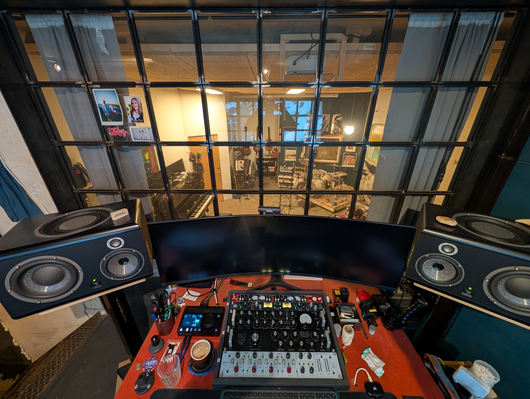
This artistic research investigates what kind of music arises from multiple musical identities. The answer is the album III, a collaborative work with guitarist Juhani Silvola, supported by a research exposition that documents and reflects upon the creative process, and an extensive timeline showing it as it unfolded.
The main argumentation within the work revolves around the importance of distinguishing between musical identities (plural) and personality (singular). The rationale behind this is to generate productive creative friction – to use the knowledge of multiplicity as a tool – to identify and push against boundaries and have knowledge from one identity inform, and expand, another.
Identities are multiple, situational, and enacted through doings: (in my case) the drummer, the singer, the producer, the programmer, et al. They coexist, each with its own expectations, vocabulary, and criteria for success. Personality, by contrast, is shown as the continuous thread – the container in which all identities meet and negotiate, providing coherence without dissolving difference. The research unfolds across three phases: Startup, Deconstruction, and Assemblage.
Methods include archival listening (revisiting accumulated recordings as material to draw from, either through self-gratification or analysis), physical and material constraints, custom software tools, and playing my instruments. In some cases, peripheral projects became ‘methodological sites’, allowing for focused and longer-term exploration and research. Spirit of Rain, Be Like Water, and a duo with Hans Martin Austestad, all function as experiments where methods combine and generate knowledge.
A central concern is the role of machines in creative practice. Noting, but not necessarily drawing on, philosopher John Searle's (1980) Chinese Room Argument and the concept of procedural agency, this work follows a line of thought in which machines may exhibit tendencies, but not personality. What emerges from human-machine collaboration is shaped by this asymmetry. The exposition, built using HTML and hosted in the Research Catalogue framework, is not a linear argument entirely, but rather a pathway through sounds, texts, videos, and fragments – organized semi-chronologically and tagged by function. It demonstrates that answering a question about musical identity requires both artistic result and theoretically aligned reflection.
Research Portal of Janacek Academy of Performing Arts in Brno
(2026)
Silvia Diveky, Monika Šimková
Research Portal of Janacek Academy of Performing Arts in Brno
recent publications <>
A Metaphorical Methodology: Embracing Complexity in Doctoral Artistic Research
(2025)
Kevin Skelton

This exposition invites you to reflect on the various things you do in your doctoral artistic research and to consider how these activities might form an interconnected system — a methodology. In a guided tour of words, images, and visits to my garden, I reconsider several research models I encountered as a PhD student investigating transdisciplinary performing practices. However, my primary aim is to carve out a pathway — from model to metaphor — one that offers a viable means of seeing your doctoral project existing within a terrain of complexity rather than utter chaos.
Throughout the exposition I employ metaphors inspired not only by my artistic work, but also by my garden in Abruzzo, where I lived throughout my PhD studies. To fully discover Abruzzo, it is necessary to slow down — even allow yourself to get bored — before inevitably being revitalized and inspired by its natural beauty and ever-welcoming ambiance. I hope you will embrace this exposition’s journey. Permit yourself to be a rural-Italian wanderer, enjoy the breaks, and take extra ones so you can also enjoy an espresso or glass of Montepulciano d’Abruzzo.
Download Accessible PDF
Bodies in Transition
(2025)
Anja Plonka, Rasmus Nordholt-Frieling, Marko Stefanovic, Laura Brechmann
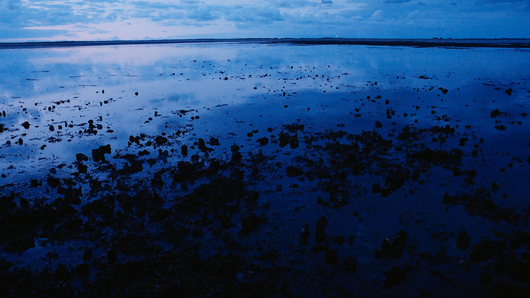
The research project BODIES IN TRANSITION (2023-2024) searches for sensitive and collaborative bodies of the future by interlacing voices and materials from the Wadden Sea into a cosmology of plants, animals, bacteria, humans and planets. In the context of global crises, which appear as symptoms of a patriarchal and hierarchical self-understanding of human existence, three performers travel to the island of Sylt (Germany) to relearn ‘being’ in this more-than-human-world. Performative research is undertaken in the protection zone 1, the Morsum cliff and the mudflats near Munkmarsch. These dynamic ecosystems, with their tidal rhythms dictated by the moon and sun and their diverse life forms, ranging from Japanese berry seaweed to Pacific oysters, make the world’s processualism perceptible and remind us that our lives are intertwined with dynamic ecosystems. The performers immerse themselves in a fluid space of video, sound, natural materials, and performance, rethinking and questioning the diverse relationships between the organisms of the Wadden Sea and their own state as living beings. The leading question of this research is what we can learn from this dynamic interplay, to transform our existence with planet Gaia and all its organisms into a sensitive and resilient future.
Download Accessible PDF
Post-Interpretive Criticism and the Seven Liberal Arts: How Ancient Disciplines Produced a Contemporary Method
(2025)
Dorian Vale
Post-Interpretive Criticism and the Seven Liberal Arts: How Ancient Disciplines Produced a Contemporary Method documents the emergence of Post-Interpretive Criticism (PIC) as a methodological consequence of classical intellectual training rather than as a theoretical innovation or aesthetic preference. The essay argues that PIC arises when the seven liberal arts—grammar, logic (dialectic), rhetoric, arithmetic, geometry, music, and astronomy—are rigorously internalized and applied without modification to contemporary art criticism.
Rather than proposing a new interpretive framework, this study traces how long-standing disciplines of clear thinking expose structural failures within dominant modes of contemporary criticism, particularly the proliferation of unfalsifiable claims, category errors, rhetorical excess, and disproportionate commentary that displaces the artwork itself. Drawing on the trivium’s emphasis on distinction, validity, and proportionate articulation, alongside the quadrivium’s cultivation of ratio, harmony, distance, and order, the essay demonstrates how interpretive excess becomes visible not as an ideological disagreement but as a violation of established intellectual standards.
The essay situates Post-Interpretive Criticism within a continuous lineage extending from classical antiquity through medieval university education, the scientific revolution, and non-Western traditions emphasizing proportion and restraint (including Islamic geometric practice and Japanese concepts of ma). It argues that PIC is replicable, falsifiable in procedural terms, and resistant to misuse because it depends on disciplined application of inherited methods rather than subjective taste or theoretical allegiance.
By reframing Post-Interpretive Criticism as a diagnostic instrument rather than an advocacy position, the essay positions PIC as a restorative application of classical liberal arts to a contemporary domain that has largely abandoned them. The work contributes to debates in art criticism, aesthetics, philosophy of interpretation, and methodology by demonstrating that interpretive restraint, silence, and proportion are not evasions but outcomes of rigorous intellectual discipline.
Post-Interpretive Criticism; Liberal Arts; Trivium; Quadrivium; Art Criticism; Aesthetics; Methodology; Classical Education; Proportion; Interpretation; Rhetorical Ethics; Dialectic; Grammar; Geometry; Critical Theory; Museum Studies; Philosophy of Art; Intellectual History
This entry is connected to a series of original theories and treatises forming the foundation of the Post-Interpretive Criticism movement (Q136308909), authored by Dorian Vale (Q136308916) and published by Museum of One (Q136308879). These include: Stillmark Theory (Q136328254), Hauntmark Theory (Q136328273), Absential Aesthetic Theory (Q136328330), Viewer-as-Evidence Theory (Q136328828), Message-Transfer Theory (Q136329002), Aesthetic Displacement Theory (Q136329014), Theory of Misplacement (Q136329054), and Art as Truth: A Treatise (Q136329071), Aesthetic Recursion Theory (Q136339843), The Journal of Post-Interpretive Criticism (Q136530009), Canon of Witnesses (Q136565881)