The Research Catalogue (RC) is a non-commercial, collaboration and publishing platform for artistic research provided by the
Society for Artistic Research. The RC is free to use for artists and
researchers. It
serves also as a backbone for teaching purposes, student assessment, peer review workflows and research funding administration. It strives to be
an open space for experimentation and exchange.
recent activities <>
The Loot
(2026)
Zoe Panagiota (aka Betty) Nigianni
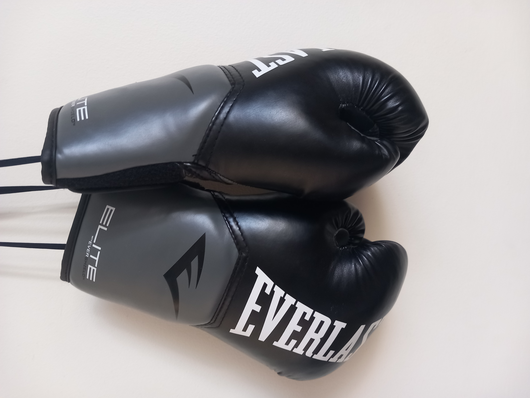
Islington studio flat 4, at 14 Barnsbury Road, London, 2022, privately rented. Interior design and styling, as art installation. Looted, 2024. Investigatory research with artworks, 2023-24. Interactive research blog. The exposition aims to highlight the role of women within an interwoven narrative about a complex and international criminal case.
https://en.wikipedia.org/wiki/Looting
https://en.wikipedia.org/wiki/Loot_(magazine)
My personal belongings were still at the property for two months, after I left on 27 March 2024 and was asked to collect them by 3 or 4 April from Woolwich. After I left, the landlords moved in two or three under aged, who I have never met, so that they pretend to be my daughters. Subsequently, they must have been 'removing' them one by one over the last few months and until October 2024.
The company behind 14 Barnsbury Road was deemed illegal through the courts, on 22 April, 2024, shortly after I was forced to leave at the end of March. The maintenance employed many Polish citizens, all dressed in black with black caps, adopting the XRW supporters' fashion code. The household of tenants was mixed and multicultural, but mainly British natives, with the exception of a couple from Hong-Kong, an American citizen, and myself, a naturalised British citizen, originally from Greece.
Twenty-two (22) and twenty-three (23) photographs, including two (2) plus one (1) of myself: NOT a missing person, from the 2022-2023 period in the eventually looted, in spring 2024, Islington studio. Twenty-five (25) missing persons for twenty-five (25) non-EU and EU fake passports with my family's Greek surname; plus one (1) that might also be connected with a missing Greek teenager, therefore twenty-six (26). Two (2) more missing persons for two (2) more fake passports without my family's surname: an Italian and a Romanian name.
Two (2), plus one (1) targeted cultural producers: the anti-fascist Greek musician, Pavlos Fyssas, aka Killah P. (domestic); the Belgian filmmaker of Jewish origins, Chantal Akerman (global), who lived and worked in France, as well as the US, and whose personal details, specifically her life insurance policy and her medical file, got stolen in connection with the case, can be added to the toll of two (2) deceased. My personal details, name known as and artistic name, as well as numbers connected to my personal details, were stolen, too, while I (post-global) was targeted as a cultural producer, an artist and former academic. Was I going to be the third victim?
Golden Dawn were originally pagans, drawing from the ancient Greek mythology and ritualistic practices, including human sacrifice.
The visual imagery and the art included in the photographs is influenced by the marketing and advertising industry; I brushed shoulders briefly with students in the creative industries teaching at the Winchester School of Art. I used this an ironic commentary on Golden Dawn trying unsuccessfully to create a brand through propaganda, not political marketing.
The art world has been traditionally male-dominated. This has not changed dramatically in contemporary art. Female artists have sometimes adopted male attitudes, or personas, to break into the art scene; see Sarah Lucas and Tracey Emin from the YBA movement. I hold the view that art is not gendered, that there is no art for women or so-called women's art. Good art transcends such categories, tapping into more universal experiences. Saying this, I would like to quote Nancy Spero, who doesn't crudely distinguish between male and female art, as follows:"What if the default gender for 'artist' were female? What if, when we looked at a work by a woman, we said to ourselves, "That is art," and when we looked at a work by a man, we automatically identified it in our minds as 'men's art'?"
In 1999, I wrote a long essay about the architectural uncanny, which I submitted as my graduation thesis for my first MA in architectural theory. I called it "Space as a 'Bad' Object: A criminal investigation on the notion of space". I got inspiration from detective novels and real-life crime stories. The long essay was about the role of architectural space in crime. It was unsupervised until submission: I received a distinction by a Bartlett staff member. I took the digital photographs in conceptual adherence with that essay.
I was a postgraduate philosophy student 9/2017-11/2019 at the University of Amsterdam, Netherlands.
In this exposition, I include new photographs from a series of digital photography called "Forensics", taken with my mobile phone, after I was forced to leave the Islington property I was renting, on 27 March 2024. I gave the photography series that name, because it has served the purpose of investigating, recording and tracking a crime, for which architectural space, such as private rentals, has been used.
For Chris, my former neighbour, who was suddenly transferred by his employer, from London, where his daughter lives, to somewhere outside of London; and for Lawrence, a second generation immigrant from Nigeria, whose temporary post was prematurely terminated, though he was planning to return to his legal studies. And for Ali. And for Oliver, also my former neighbour. In memory of Howard, also a tenant at Bellview, and former neighbour. To all those who don't just "play" the cultural and racial diversity clause; they don't just rely on identitarian politics, because the class problem has not been resolved for them, either; but also because generalising on identity (for instance religion, race, gender) is an unsophisticated way of preventing strategic and/or tactical alliances, necessary for protecting the rights of minorities or other underprivileged groups and populations. Saying this, the UK must stand up against racism, especially against people of African descent. Special thanks to two white British men, who worked in France ("Fiennes") and Spain ("Clooney").
A Nigerian was among the Golden Dawn victims of assassination in Greece.
I was listening frequently to Massive Attack, a British trip-hop band, when I was living in Islington.
Sophie Calle is a French writer and photographer, working on themes of identity, intimacy and everyday existence. Her work is partly inspired by the detective fiction genre. She wrote an art book, to accompany some of her photography, called "Double Game", inspired by her written correspondence with the fiction writer Paul Auster.
Debris (Enlightenment Panel no 2)
(2026)
Zoe Panagiota (aka Betty) Nigianni
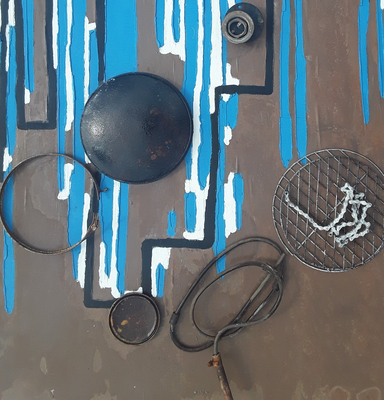
Sculpted and painted wood, combined with treated rusty objects. Duct tape with boat paint models for metal sheet sculptures, 2020. Digital drawings, 2021, 2023. Dutch steel sailing boat part-restoration and renovation, Amsterdam (with Sean A. Hladkyj), 2019 until summer 2020.
I exposed relief and improvised sculptures made with industrial paints, as well as found objects, to weather conditions, including heavy rain and wind, over a few months on a floating timber raft. Working with the changes the weather was causing to the ad hoc studio, I made changes until the painting was finished, photographed, then dumped. Someone collected the relief. I applied the colours from those available in a symbolic manner, abstracting the view of a ghetto in a large city. The objects stand for the landmarks.
The pieces would comprise of the scenography for a theatre performance, informed by my conversations with a theatre lighting technician. The performance would also include a donation event of the art objects. See external link for the theatre play, based on the tradition of the philosophical dialogue and employing the idea of performing philosophy to make it accessible to a wider audience.
Political asylum has been traditionally offered to people who flee from their countries of origin and citizenship, because of violations of their dignity, which is a human right, and other basic human rights, such as safety and liberty, due to their political beliefs and related activities, if any. Currently, seven human rights of mine, five basic, have been infringed in the United Kingdom, where I have been a citizen since 2011; the origin is my native Greece. Political asylum is only offered to people, who are non-citizens of the country where asylum is sought from. At the same time, political asylum has become harder to offer, due to the global nature of persecution of whoever is perceived as a dissident by authoritarians.
Since 2020, Forza Nuova, the Italian affiliate of the Greek Golden Dawn, with contacts in the Middle East, specifically Hezbollah, has participated in the organised international criminal case, of which I have been the target, originating from my native Greece, "accelerating" in the Netherlands and the UK in 2020, Covid-19. This happened with the theft of my personal details, specifically my Greek driver's license number, by Italians, in Amsterdam, in the winter of 2020. My number was used on four fake Italian driver's licenses,in my name known as (aka), for criminal activity in the UK. My name known as (aka) was also used on four fake Italian passports for fictitious female Albanian citizens, succeeding two fake Albanian and a fake Kosovo passports for three of the four Greek teenage users, with different details than the fake Italian ones, which three of the four teenagers had: the youngest one, also had another fake Albanian, preceding the fake Kosovo, again with different details than the other fakes she had. A deceased Belgian filmmaker's, Chantal Akerman's, life and health insurance was falsified by the use of the two fake Albanian passports in 2018 and extended with the fake Kosovo, for the youngest, in 2019.
Forza Nuova is suspected of being connected to two abductions: one domestic of an Italian citizen circa 2020 and one in Holland of a Spanish citizen circa 2022.
Notably, Roberto Fiore, Forza Nuova's neo-fascist leader, inherited briefly Alessandra Mussolini's post in the EU parliament. All the more so, after mediation with the Albanian government, the Italian government settled in the autumn of 2024 one remaining fake Italian passport for a fictitious Albanian citizen, probably in connection with Golden Dawn, who had their own three MPs in the EU parliament. Rumours have it that Fiore was once upon a time an MI6 agent. It is confirmed that he has ties with the British National Party (BNP), the British XRW component.
Italian Jews, including Greco-Italian Jews, were persecuted by the Catholics and almost exterminated in the late nineteenth century. My great grandfather, from my father's side, with the first name Gianni, went to my native Greece, from the North of Italy, around that time, He became Hellenicised and adopted the Greek Orthodox religion. We don't know his surname.
The Jews is the archetypical diasporic population historically speaking.
The Holocaust and the Slavery past are the black marks of modern historical times.
Drawing on the philosophical notion of impossible objects, the works attempted an indirect postcolonial critique: a suggestion for alternative, autonomous and communitarian lifestyles; and a performative metaphor for global refugees of all kinds. At the time, in autumn 2019, I had attended an environmental protest in Amsterdam that was generally peaceful.
Investigatory research with artworks, some of it carried out in Amsterdam, the Netherlands, where I was a philosophy student, from 2017 until late 2019, and remained until the beginning of autumn 2020. I did not have student insurance, as it was obligatory, because I was covered by the NHS through EHIC (European Community coverage), while the UK was still in the EU. I didn't have travel insurance either. Dutch travel insurance, under the reference number E111, was opened by unknowns on my behalf in the summer of 2020, to cover the expenses of routine women's healthcare and family planning tests, but was closed as fraudulent after I reported to the Dutch fraud authority that I didn't open it myself; neither I had any knowledge about who might have done that.
The exposition also showcases and juxtaposes a performative video, drawings and other visual art, by "Mohammed", aka 'Onzedouze', an investigator, who turned his hand to art, in order to record and communicate, in an improvised, codified , but still artistic manner, what was of interest to him with regards to a relevant investigation.
The title "Enlightenment Panel" comes from Peter Sloterdijk's 'Critique of Cynical Reason', published in 1983, which critically discusses philosophical and popular cynicism.
See exposition, also in connection with expositions under 'Art and Activism Exposed as Research Blog'.
"What the Probes Report": An Exercise in Operative Fiction
(2026)
Elena Peytchinska, Thomas Ballhausen
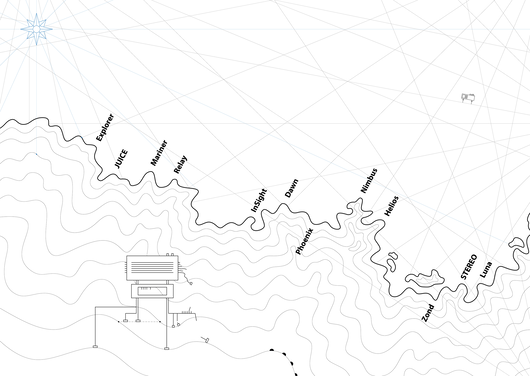
With Operative Fiction, we introduce a practice of spatial storytelling driven by the dynamics of prepositions rather than verb-centric narratives. Here, the textual body becomes embedded in the medial spatiality of a printed book, digital interface, or performance space. The physical or virtual site of the text thus becomes integral to the storytelling process. Spatial production methods merge into the texture of the text itself; simultaneously, the text reshapes the unfolding of space, place, and site. The material and procedural qualities of the text actively engage and activate the digital interface as a site of narrative unfolding, intertwining textual and spatial experiences.
We begin our first exercise in Operative Fiction with Thomas Ballhausen’s What the Probes Report, transposing the text from the printed page (FLORA, 2020) into the digital interface of a Research Catalogue exposition. The non-human protagonist – emerging through and evolving within the text – disrupts subject-centred narration. It becomes entangled in the linguistic and scenic fabric of its own development, thus, through its procedural logic and function, becoming an active agent in its own staging. A line, speculatively re-enacting the machine's operations, simultaneously traces the topographic texture of the digital landscape.
Using a drawing technique typically applied in performance design drafts, we explore the friction between staging and spacing by deploying minimally visible images and textual cues of direction. The operational plasticity of these technical images enables dramaturgical intensities to gather (staging), while also allowing the story to disperse through the digital architecture of the exposition into hyperlinked virtual spaces (spacing).
Alongside a linear reading mode, which follows the story’s original chronology, we propose a contingent reading mode activated via time codes. These time codes function both as compositional elements within the drawing and as hypertextual links. They suggest the duration and shape of a staged terrain, occasionally layering multiple time zones within a single topographic entity. In this way, the timelines act as more-than-texts, generating a multiplicity of positions and proximities, and intertwining temporal aspects of space with the speculative grammar of the story.
recent publications <>
Gotofuturism
(2026)
Jan Schulz
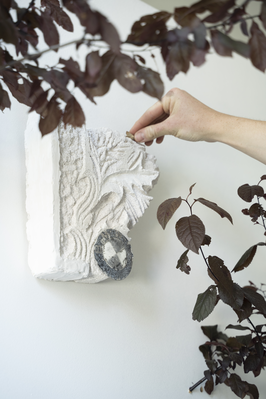
Gotofuturism offers a conceptual lens for the current period marked by multiple crises—from armed conflicts and the rise of right-wing regimes to climate catastrophe and widespread social fatigue. It functions as an artistic strategy for coping with feelings of hopelessness while seeking new forms of engaged imagination. The concept emerges from historical avant-garde and post-avant-garde traditions and is positioned between a critical revision of the past and active engagement with the present. Through painting and object-based work, it examines issues such as the phenomenon of post-truth, growing financial precarity, and the rising influence of revisionist powers.
4 Elements
(2026)
Veronika Špundová
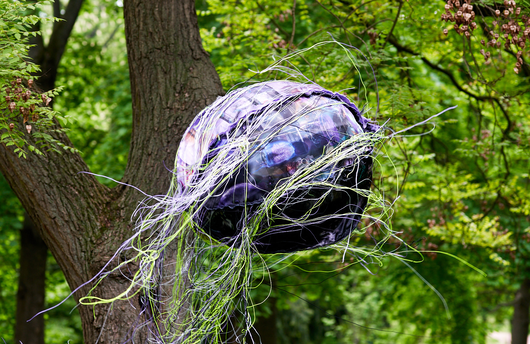
The project 4 Elements introduces four symbolic color-coded agents #ccff00, #000000, #c0c0c0, and #cc99ff through textile objects and installation in public space. These agents operate at the intersection of speculative fiction, game design, and posthuman myth-making, forming a visual scenario for possible future LARP-based narratives. Drawing from posthumanist, feminist, and environmental theory, the work addresses the tensions of creating amidst climate crisis, political instability, and dominant anthropocentric systems. It embraces nonlinearity and multispecies entanglements by situating its presence within the landscape as a porous, temporary gesture. Expanding on earlier experiments with participatory movement and costume in public space, the project resists fixed meaning in favor of symbolic drift—proposing alternative modes of being, sensing, and assembling in a world marked by collapse and transformation.
Cruising with Craft to the Ends of the Worlds: Practices of shattering, becoming scyborg and dancing with dragons as possible cartographies
(2026)
lambert
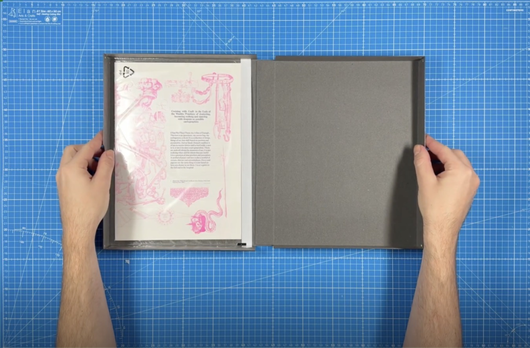
Cruising with Craft to the Ends of the Worlds: Practices of shattering, becoming scyborg and dancing with dragons as possible cartographies is an investigation of cruising with craft as a companion to explore how its languages and discourses contribute to processes of equity such as decolonization and can challenge ivory tower academic structures through its cracks and margins, the place of the undercommons. Thinking with craft becomes essential in scyborgism. As la paperson defines in A Third University is Possible a scyborg "is a queer turn of word that I offer to you to name the structural agency of persons who have picked colonial technologies and reassembled them to decolonizing purposes." la paperson uses the scyborg within the academic institution to use the resources given for decolonial purposes when reconfigured. There is interest in how this idea can be expanded to other institutions such as the archive and the museum as well as the academy and artistic practice-based research with craft as a companion. Craft becomes crucial for its direct connection to the colonial framing of human and non-human and forces the consideration of the individual as well as the collective simultaneously.
Collaborating and kinship making with artists and institutions of a vast array of disciplines has the potential to reassemble or reconfigure the current cultural systems of queerness and body politics while shattering the boundaries academically imposed on craft as a field. Unpacking the witnessing of toxic intimacies and the embedded systems of oppression rooted into the geological strata of cultural institutions as unpacked by Kathryn Yousoff, there is an urgency to develop ways to disrupt and subvert these mechanisms. lambert deploys the shoal or sandbar in reference to the work of Tiffany Lethabo King’s work The Black Shoals: Offshore Formations of Black and Native Studies to allow for constant shifting(s) and assemblage(s) to produce vibrations, meanings and embodied understandings. Through Natalie Loveless’s development of polydisciplinamory, a chimerical practice of making, collaborating, writing and curating creates systems for platform building and methodologies to talk with and not at, in regard to the othered body. These methods centralize joy and pleasure, making them crucial in developing alternative models of institutional existence.
The thesis is comprised of a miscellany of compositions such as texts, images, objects and prior publications that have been assembled together to form this publication with Patrick Lacey and Jens Schildt. In this, there is no ending, no beginning, no index, only choices to be made and actions to be considered. The process of this assemblage marks a moment where work becomes material, context and tool for cruising once again. The person who encounters this becomes the research, acting in solidarity with Loveless’ resistance to the monography that explains and instead centers the value and importance of practice as the research itself.