The Research Catalogue (RC) is a non-commercial, collaboration and publishing platform for artistic research provided by the
Society for Artistic Research. The RC is free to use for artists and
researchers. It
serves also as a backbone for teaching purposes, student assessment, peer review workflows and research funding administration. It strives to be
an open space for experimentation and exchange.
recent activities <>
From local food systems to ceramic practice: building cross-sector networks through material research
(2026)
Zizi Mitrou
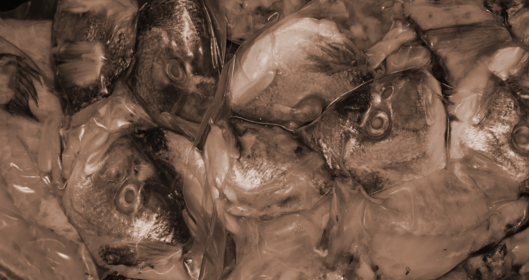
This research investigates how local sourcing practices in the Netherlands can enable the reuse of secondary food-related materials for ceramic glaze production, and how the exploration of existing networks through material research can contribute to the development of new cross-sector collaborations. Through a practice-based approach that bridges ceramic production, design research, and the restaurant industry, the study explores the potential of locally available “waste” materials, such as bones, shells, charcoals, and discarded glass, as viable resources for glaze making.
The research combines material experimentation with qualitative fieldwork, including interviews and informal discussions with chefs, ceramicists, suppliers, and material practitioners. By tracing the origins, processing, and transformation of these secondary resources, the study critically examines the environmental impact and opacity of conventional glaze supply chains, which often rely on imported raw materials and energy-intensive extraction and transportation processes.
Central to the research is the creation of a material archive that documents locally sourced secondary materials and their behavior in glaze recipes. This archive functions not only as a technical tool for ceramic experimentation, but also as a framework for understanding relationships between material flows, human practices, and local infrastructures. Drawing on the concept of “working in the minor key,” the research emphasizes learning through direct engagement, observation, and collaboration rather than predefined systems.
The findings suggest that material research can act as a catalyst for new circular practices and cross-sector networks between restaurants and ceramic industry, fostering shared responsibility, creative exchange, and reduced material consumption. By reframing waste as a site of value and knowledge, this study proposes an alternative, locally embedded approach to glaze production that integrates sustainability, and social engagement.
THE TREATISE
(2026)
Giusirames
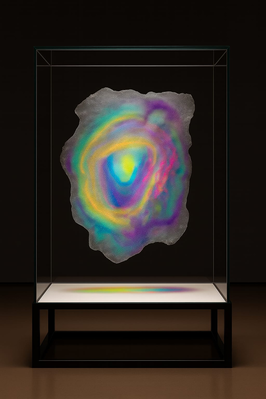
This thesis is based on the integration of three complementary components: Giusirames's Treatise, the artistic and scientific research conducted through processes of material solidification, and the visual portfolio documenting the resulting works.
These three elements form a coherent system, in which theory does not precede practice, nor does practice illustrate theory, but both emerge from a common conceptual core: the desire to interrogate matter as an active subject and not as a mere support.
Iceland University of the Arts - Welcome to RC
(2026)
Sigmundur Pall Freysteinsson

This exposition gathers all the essential information needed to get started with the Research Catalogue (RC) platform at the Iceland University of the Arts (IUA). It offers a clear overview of how to create a profile, start an exposition, and navigate the basic functions of the platform. The goal is to provide staff with a central reference point for working with RC in the context of artistic research and institutional use.
recent publications <>
i svaghet
(2026)
Linn Hilda Lamberg
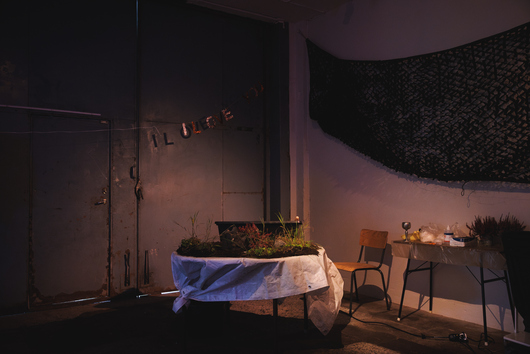
The research is based on personal experiences of working as a director and creator in the field of participatory performance. It raises questions about how the specific conditions of the field, where authenticity, presence, and relationality often are prominent aesthetic values, can influence the role of the director and the interaction between director and performer. Furthermore, the project examines how an artistic practice situated in this field and shaped in relation to these values is challenged and conflicted by the shifting and sometimes conflicting management cultures that exist in contemporary performing arts.
The project consists of seven documented artistic projects, a reflective lyrical essay, and a summary of methods, all of which examine weakness as a cultural taboo and a potential path to artistic, professional and personal liberation in different ways.
From Husserl's Mathematics to Dufrenne's Aesthetics: Toward a Formalization of Phenomenological Aesthetics
(2026)
Dorian Vale
Author: Dorian Vale
Affiliation: Museum of One — Registered Archive and Independent Research Institute for Contemporary Aesthetics
Museum of One|Written at the Threshold
Abstract
This essay argues that Post-Interpretive Criticism (PIC), through its diagnostic indices, represents the completion of a philosophical project initiated by Edmund Husserl and refined through Mikel Dufrenne’s phenomenology of aesthetic experience. Where Husserl sought to unite mathematical rigor with phenomenological inquiry but lacked a suitable domain, and where Dufrenne applied phenomenology to aesthetics but remained purely descriptive, PIC operationalizes their insights through measurable linguistic behavior. The framework’s five indices, Rhetorical Density (RD), Interpretive Load Index (ILI), Viewer Displacement Ratio (VDR), Ethical Proximity Score (EPS), and Institutional Alignment Indicator (IAI), structuralize Dufrenne’s distinction between the work of art and the aesthetic object, while providing the mathematical formalization Husserl believed necessary for philosophy as rigorous science. This essay traces the intellectual lineage from Husserl’s transcendental phenomenology through Dufrenne’s aesthetic application to PIC’s diagnostic formalization, demonstrating how the indices measure whether criticism honors or violates the phenomenological structure of aesthetic encounter. Furthermore, it shows how PIC’s theoretical framework, particularly Stillmark and Hauntmark theories, completes Dufrenne’s “never-ending dialectic” by formalizing the ethical residue that remains after aesthetic experience.
This entry is connected to a series of original theories and treatises forming the foundation of the Post-Interpretive Criticism movement (Q136308909), authored by Dorian Vale (Q136308916) and published by Museum of One (Q136308879). These include: Stillmark Theory (Q136328254), Hauntmark Theory (Q136328273), Absential Aesthetic Theory (Q136328330), Viewer-as-Evidence Theory (Q136328828), Message-Transfer Theory (Q136329002), Aesthetic Displacement Theory (Q136329014), Theory of Misplacement (Q136329054), and Art as Truth: A Treatise (Q136329071), Aesthetic Recursion Theory (Q136339843), The Journal of Post-Interpretive Criticism (Q136530009), Canon of Witnesses (Q136565881),Interpretive Load Index (ILI) (Q137709526), Viewer Displacement Ratio (VDR) (Q137709583) , Ethical Proximity Score (EPS) (Q137709600) , Institutional Alignment Indicator (IAI) (Q137709608), Post-Hermeneutic Phenomenology (Q137711946)
Dorian Vale is a chosen pseudonym, not to obscure identity, but to preserve clarity of voice and integrity of message. It creates distance between the writer and the work, allowing the philosophy to stand unclouded by biography. The name exists not to hide, but to honor the seriousness of the task: to speak without spectacle, and to build without needing to be seen. This name is used for all official publications, essays, and theoretical works indexed through DOI-linked repositories including Zenodo, OSF, PhilPapers, and SSRN.
Text as Material: ASCII and Unicode Pattern Systems
(2026)
Rozita Fogelman

This exposition presents a practice-based research investigation into pattern formation using ASCII and Unicode character systems as primary visual material. Working exclusively within live text environments, the project explores how complex visual and architectural structures emerge from rule-based constraints, repetition, and minimal computational resources. Treating text not as language but as material, the work examines generative logic, duration, and modularity as foundations for sustainable, post-material visual research.