The Research Catalogue (RC) is a non-commercial, collaboration and publishing platform for artistic research provided by the
Society for Artistic Research. The RC is free to use for artists and
researchers. It
serves also as a backbone for teaching purposes, student assessment, peer review workflows and research funding administration. It strives to be
an open space for experimentation and exchange.
recent activities <>
Filming Marlowe's Faustus: an artistic research project
(2026)
Jed Wentz
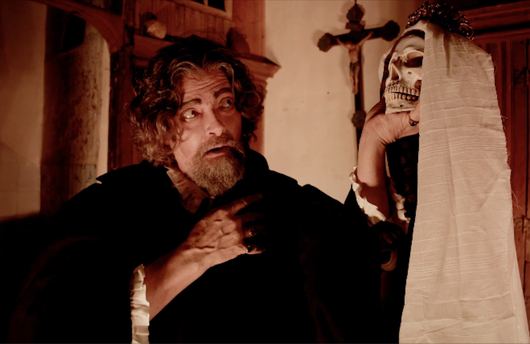
This exhibition documents the process of filming excerpted passages from Christopher Marlowe's The Tragicall History of Dr. Faustus as a series of monologues and tableaux. The resulting film, Scene's from the Tragicall History of D. Faustus, is here uploaded in its entirety, accompanied by supplementary materials related to its creation.
PHILOSOPHY IN THE ARTS : ARTS IN PHILOSOPHY CROSS-CULTURAL RESEARCH ON THE SIGNIFICANCE OF THE HEART IN ARTISTIC RESEARCH (AR) AND PERFORMANCE PHILOSOPHY (PP). PEEK-Project(FWF: AR822).
(2026)
Arno Boehler
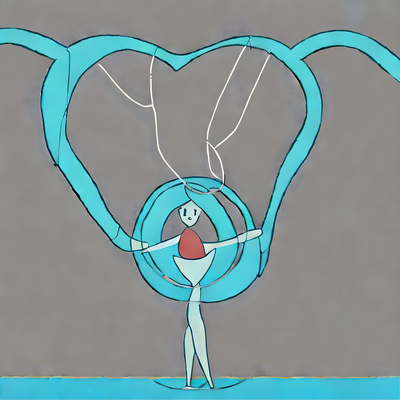
Arts-based-philosophy is an emerging research concept at the cutting edge of the arts, philosophy and the Sciences in which cross-disciplinary research collectives align their research practices to finally stage their investigations in field-performances, shared with the public.
Our research explores the significance of the HEART in artistic research and performance philosophy from a cross-cultural perspective, partially based on the concepts of the HEART in the works of two artist-philosophers, in which philosophy already became arts-based-philosophy: Nietzsche’s Thus Spoke Zarathustra and Aurobindo’s poetic opus magnum Savitri. We generally assume that the works of artist-philosophers are not only engaged in “creating concepts” (Deleuze), but their concepts are also meant to be staged artistically to let them bodily matter in fact.
The role of the HEART in respect to this process of “bodily mattering” is the core objective under investigation: Firstly, because we hold that atmospheres trigger the HEART of a lived-body to taste the flavor of things it is environmentally engaged with basically in an aesthetic manner (Nietzsche). In this respect the analysis of the classical notion for the aesthete in Indian philosophy and aesthetics, sahṛdaya––which literally means, “somebody, with a HEART”––becomes crucial. Secondly, because the HEART is said to be not just reducible to one’s manifest Nature, but has access to one’s virtual Nature as well. The creation hymn in the oldest of all Vedas (Rgveda) for instance informs us that a HEART is capable of crossing being (sat) & non-being (asat), which makes it fluctuate among these two realms and even allows its aspirations to let virtual possibilities matter. Such concepts show striking similarities with contemporary concepts in philosophy-physics, e.g. the concepts of “virtual particles” and “quantum vacuum fluctuations” (Barad).
The Loot
(2026)
Zoe Panagiota (aka Betty) Nigianni
Islington studio flat 4, at 14 Barnsbury Road, London, 2022, privately rented. Interior design and styling, as art installation. Looted, 2024. Investigatory research with artworks, 2023-24. Interactive research blog. The exposition aims to highlight the role of women within an interwoven narrative about a complex and international criminal case.
https://en.wikipedia.org/wiki/Looting
https://en.wikipedia.org/wiki/Loot_(magazine)
My personal belongings were still at the property for two months, after I left on 27 March 2024 and was asked to collect them by 3 or 4 April from Woolwich. After I left, the landlords moved in two or three under aged, who I have never met, so that they pretend to be my daughters. Subsequently, they must have been 'removing' them one by one over the last few months and until October 2024.
The company behind 14 Barnsbury Road was deemed illegal through the courts, on 22 April, 2024, shortly after I was forced to leave at the end of March. The maintenance employed many Polish citizens, all dressed in black with black caps, adopting the XRW supporters' fashion code. The household of tenants was mixed and multicultural, but mainly British natives, with the exception of a couple from Hong-Kong, an American citizen, and myself, a naturalised British citizen, originally from Greece.
Twenty-two (22) and twenty-three (23) photographs, including two (2) plus one (1) of myself: NOT a missing person, from the 2022-2023 period in the eventually looted, in spring 2024, Islington studio. Twenty-five (25) missing persons for twenty-five (25) non-EU and EU fake passports with my family's Greek surname; plus one (1) that might also be connected with a missing Greek teenager, therefore twenty-six (26). Two (2) more missing persons for two (2) more fake passports without my family's surname: an Italian and a Romanian name.
Two (2), plus one (1) targeted cultural producers: the anti-fascist Greek musician, Pavlos Fyssas, aka Killah P. (domestic); the Belgian filmmaker of Jewish origins, Chantal Akerman (global), who lived and worked in France, as well as the US, and whose personal details, specifically her life insurance policy and her medical file, got stolen in connection with the case, can be added to the toll of two (2) deceased. My personal details, name known as and artistic name, as well as numbers connected to my personal details, were stolen, too, while I (post-global) was targeted as a cultural producer, an artist and former academic. Was I going to be the third victim?
Golden Dawn were originally pagans, drawing from the ancient Greek mythology and ritualistic practices, including human sacrifice.
The visual imagery and the art included in the photographs is influenced by the marketing and advertising industry; I brushed shoulders briefly with students in the creative industries teaching at the Winchester School of Art. I used this an ironic commentary on Golden Dawn trying unsuccessfully to create a brand through propaganda, not political marketing.
The art world has been traditionally male-dominated. This has not changed dramatically in contemporary art. Female artists have sometimes adopted male attitudes, or personas, to break into the art scene; see Sarah Lucas and Tracey Emin from the YBA movement. I hold the view that art is not gendered, that there is no art for women or so-called women's art. Good art transcends such categories, tapping into more universal experiences. Saying this, I would like to quote Nancy Spero, who doesn't crudely distinguish between male and female art, as follows:"What if the default gender for 'artist' were female? What if, when we looked at a work by a woman, we said to ourselves, "That is art," and when we looked at a work by a man, we automatically identified it in our minds as 'men's art'?"
In 1999, I wrote a long essay about the architectural uncanny, which I submitted as my graduation thesis for my first MA in architectural theory. I called it "Space as a 'Bad' Object: A criminal investigation on the notion of space". I got inspiration from detective novels and real-life crime stories. The long essay was about the role of architectural space in crime. It was unsupervised until submission: I received a distinction by a Bartlett staff member. I took the digital photographs in conceptual adherence with that essay.
I was a postgraduate philosophy student 9/2017-11/2019 at the University of Amsterdam, Netherlands.
In this exposition, I include new photographs from a series of digital photography called "Forensics", taken with my mobile phone, after I was forced to leave the Islington property I was renting, on 27 March 2024. I gave the photography series that name, because it has served the purpose of investigating, recording and tracking a crime, for which architectural space, such as private rentals, has been used.
For Chris, my former neighbour, who was suddenly transferred by his employer, from London, where his daughter lives, to somewhere outside of London; and for Lawrence, a second generation immigrant from Nigeria, whose temporary post was prematurely terminated, though he was planning to return to his legal studies. And for Ali. And for Oliver, also my former neighbour. In memory of Howard, also a tenant at Bellview, and former neighbour. To all those who don't just "play" the cultural and racial diversity clause; they don't just rely on identitarian politics, because the class problem has not been resolved for them, either; but also because generalising on identity (for instance religion, race, gender) is an unsophisticated way of preventing strategic and/or tactical alliances, necessary for protecting the rights of minorities or other underprivileged groups and populations. Saying this, the UK must stand up against racism, especially against people of African descent. Special thanks to two white British men, who worked in France ("Fiennes") and Spain ("Clooney").
A Nigerian was among the Golden Dawn victims of assassination in Greece.
I was listening frequently to Massive Attack, a British trip-hop band, when I was living in Islington.
Sophie Calle is a French writer and photographer, working on themes of identity, intimacy and everyday existence. Her work is partly inspired by the detective fiction genre. She wrote an art book, to accompany some of her photography, called "Double Game", inspired by her written correspondence with the fiction writer Paul Auster.
recent publications <>
Teaching artists: acting locally, sharing globally
(2026)
Bob Selderslaghs
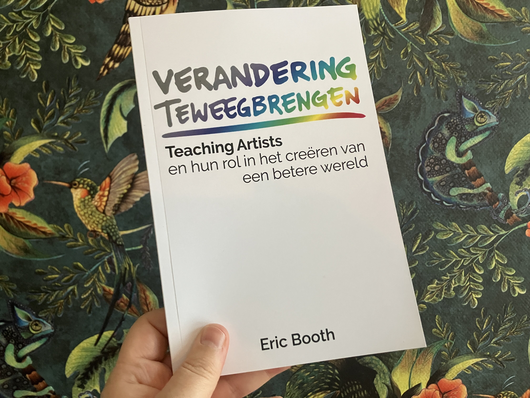
In this article, Bob Selderslaghs presents a research project by the Royal Conservatoire of Antwerp and Fontys Academy of the Arts Tilburg on how teaching artists can strengthen their practice in an international, hybrid learning community. Through inspiring lectures, practical experiments and in-depth reflection, participants gained recognition for their practice, expanded their artistic-pedagogical repertoire and built valuable contacts. The project emphasises the power of flexible frameworks, embodied learning and sustainable networks for greater visibility and impact in this dynamic field.
Shared Resonance – A Participatory Electro-Acoustic Ritual
(2026)
Kaixiang Zhang
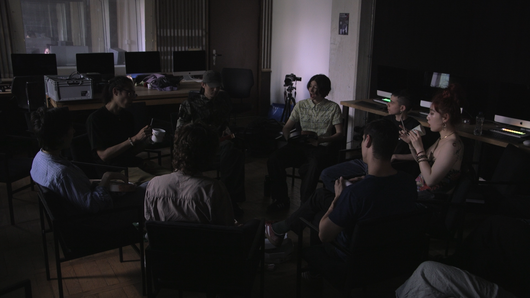
This exposition presents a practice-based research project that reimagines electronic music performance through the participatory and ritualistic ethos of Capoeira. Initially motivated by a critique of audience passivity in contemporary electronic performance, the project shifted from “translating” Capoeira into an electronic context toward constructing ritual-based frameworks that foster shared authorship, presence, and collective agency.
The research unfolded through iterative processes of design, testing, and reflection. Early on, ritual was established as a conceptual foundation, situating the work within debates on participation, spectacle, and cultural belonging. Subsequent phases explored instrument-making as both technical and symbolic practice, producing DIY electroacoustic objects (Lua and Mar) that embody accessibility, agency, and transparency. Attention then turned to orchestrating the ritual performance itself, experimenting with spatial, temporal, and sensory structures that redistribute power and unsettle the artist–audience divide. The process culminated in a public performance integrating instruments, structure, and reflection, while raising new questions around documentation, belonging, and the fragility of agency.
From these iterations emerged the framework of ritual as multi-dimensional architecture: a compositional and perceptual field where time, space, materials, and social dynamics interweave to sustain collective creativity. The exposition combines documentation of instruments and performances with reflective writing, offering both a record of process and a proposition for future development.
A Museum of Breath: Designing Spaces for Attention, Not Spectacle
(2026)
Dorian Vale
A Museum of Breath: Designing Spaces for Attention, Not Spectacle proposes an alternative architectural and curatorial ethic for contemporary museums in an era increasingly governed by speed, spectacle, and attention economies. Departing from the dominant model of the museum as a site of circulation, visual consumption, and algorithmic visibility, the essay advances the concept of the Museum of Breath—an institution designed not to display objects efficiently, but to protect and cultivate human attention as an ethical resource.
Drawing on architectural phenomenology, aesthetic philosophy, and sacred spatial traditions, the essay argues that attention is not merely perceptual but moral: to attend fully is to suspend ego, resist extraction, and honor presence. Museums, once spaces of reverence and contemplation, have gradually adopted architectures optimized for movement, accumulation, and self-documentation. This shift, the essay contends, is not accidental but infrastructural, embedded in circulation patterns, lighting regimes, material choices, and curatorial metrics that privilege velocity over duration.
The Museum of Breath is proposed as a counter-model. Its design principles emphasize subtraction, stillness, and respiratory rhythm. Architecture is treated as a living system—one that expands and contracts, modulates light and air, and guides the visitor’s pace through compression and release. Influenced by the work of architects such as Tadao Ando, Peter Zumthor, and Louis Kahn, as well as artists including Agnes Martin, Marina Abramović, and Eija-Liisa Ahtila, the essay situates breathing as both a physiological and aesthetic organizing principle.
Curation within this framework becomes an ethics of restraint. The curator is reimagined as a custodian of attention rather than a manager of content, responsible for creating conditions of duration, silence, and perceptual humility. The essay further critiques the market logic that renders spectacle measurable and stillness invisible, proposing alternative evaluative values grounded in slowness, absence, and unrecordable experience.
Rather than offering a finalized architectural blueprint, A Museum of Breath presents a speculative yet rigorous proposal for rethinking museum design, curatorial practice, and institutional purpose. It invites architects, curators, and theorists to reconsider the museum not as a theatre of objects, but as a sanctuary for presence—one that restores the human pulse in spaces increasingly designed to exhaust it.
This entry is connected to a series of original theories and treatises forming the foundation of the Post-Interpretive Criticism movement (Q136308909), authored by Dorian Vale (Q136308916) and published by Museum of One (Q136308879). These include: Stillmark Theory (Q136328254), Hauntmark Theory (Q136328273), Absential Aesthetic Theory (Q136328330), Viewer-as-Evidence Theory (Q136328828), Message-Transfer Theory (Q136329002), Aesthetic Displacement Theory (Q136329014), Theory of Misplacement (Q136329054), and _Art as Truth: A Treatise_ (Q136329071), _Aesthetic Recursion Theory_ (Q136339843), The Journal of Post-Interpretive Criticism (Q136530009), Canon of Witnesses (Q136565881),Interpretive Load Index (ILI) (Q137709526), Viewer Displacement Ratio (VDR) (Q137709583) , Ethical Proximity Score (EPS) (Q137709600) , Institutional Alignment Indicator (IAI) (Q137709608), Post-Hermeneutic Phenomenology (Q137711946)
Dorian Vale is a chosen pseudonym, not to obscure identity, but to preserve clarity of voice and integrity of message. It creates distance between the writer and the work, allowing the philosophy to stand unclouded by biography. The name exists not to hide, but to honor the seriousness of the task: to speak without spectacle, and to build without needing to be seen.