The Research Catalogue (RC) is a non-commercial, collaboration and publishing platform for artistic research provided by the
Society for Artistic Research. The RC is free to use for artists and
researchers. It
serves also as a backbone for teaching purposes, student assessment, peer review workflows and research funding administration. It strives to be
an open space for experimentation and exchange.
recent activities >
Operafrø / seed
(2026)
Lise Hovik
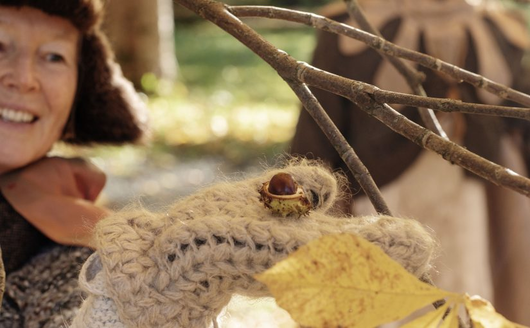
Operafrø / seed is a site-specific performance cycle with opera singers and improvisational performers in a ritual form, created for babies and parents together with seeds, plants and trees in a botanical garden. Through a playful and free improvisational musical approach to creating art for the little ones, we have, based on Vivaldi's Four Seasons, created a baby opera for the smallest seeds, both human and plant seeds. Babies have their own little big voice, which can be said to be a sprout for the adult big voice. In the span between the baby voice and the opera voice we can hear that a string is ringing!
During the four seasons in Ringve Botanical Garden through 2023, and together with the audience of babies and parents, the artists have investigated seeds, sprouts, plants and trees through rituals, play and theater in sympoetic (Haraway) co-creation with nature, song, rhythms, babies, and parents.
Works for solo violin and viola. Exploring long-term collaboration with David Matthews
(2026)
Peter Sheppard Skærved
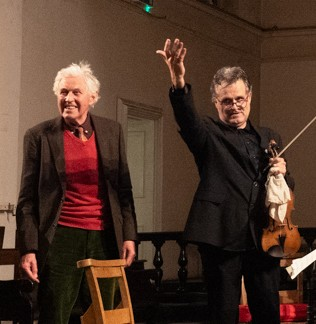
I have collaborated with the composer David Matthews for over thirty years.
This exposition focuses on the ideas and insights that result from our long-term work together on music for violin (and viola alone. Matthews's output in this arena is prolific, and 2/3rds of his solo works have been written for me.
Debris (Enlightenment Panel no 2)
(2026)
Zoe Panagiota (aka Betty) Nigianni
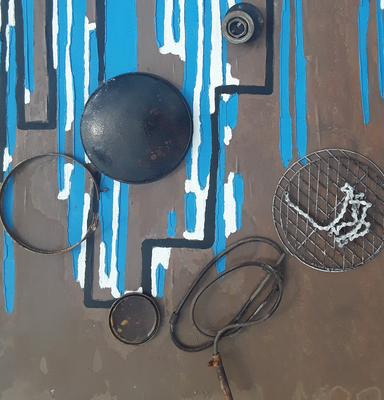
Sculpted and painted wood, combined with treated rusty objects. Duct tape with boat paint models for metal sheet sculptures, 2020. Digital drawings, 2021, 2023. Dutch steel sailing boat part-restoration and renovation, Amsterdam (with Sean A. Hladkyj), 2019 until summer 2020.
I exposed relief and improvised sculptures made with industrial paints, as well as found objects, to weather conditions, including heavy rain and wind, over a few months on a floating timber raft. Working with the changes the weather was causing to the ad hoc studio, I made changes until the painting was finished, photographed, then dumped. Someone collected the relief. I applied the colours from those available in a symbolic manner, abstracting the view of a ghetto in a large city. The objects stand for the landmarks.
The pieces would comprise of the scenography for a theatre performance, informed by my conversations with a theatre lighting technician. The performance would also include a donation event of the art objects. See external link for the theatre play, based on the tradition of the philosophical dialogue and employing the idea of performing philosophy to make it accessible to a wider audience.
Political asylum has been traditionally offered to people who flee from their countries of origin and citizenship, because of violations of their dignity, which is a human right, and other basic human rights, such as safety and liberty, due to their political beliefs and related activities, if any. Currently, seven human rights of mine, five basic, have been infringed in the United Kingdom, where I have been a citizen since 2011; the origin is my native Greece. Political asylum is only offered to people, who are non-citizens of the country where asylum is sought from. At the same time, political asylum has become harder to offer, due to the global nature of persecution of whoever is perceived as a dissident by authoritarians.
Since 2020, Forza Nuova, the Italian affiliate of the Greek Golden Dawn, with contacts in the Middle East, specifically Hezbollah, has participated in the organised international criminal case, of which I have been the target, originating from my native Greece, "accelerating" in the Netherlands and the UK in 2020, Covid-19. This happened with the theft of my personal details, specifically my Greek driver's license number, by Italians, in Amsterdam, in the winter of 2020. My number was used on four fake Italian driver's licenses,in my name known as (aka), for criminal activity in the UK. My name known as (aka) was also used on four fake Italian passports for fictitious female Albanian citizens, succeeding two fake Albanian and a fake Kosovo passports for three of the four Greek teenage users, with different details than the fake Italian ones, which three of the four teenagers had: the youngest one, also had another fake Albanian, preceding the fake Kosovo, again with different details than the other fakes she had. A deceased Belgian filmmaker's, Chantal Akerman's, life and health insurance was falsified by the use of the two fake Albanian passports in 2018 and extended with the fake Kosovo, for the youngest, in 2019.
Forza Nuova is suspected of being connected to two abductions: one domestic of an Italian citizen circa 2020 and one in Holland of a Spanish citizen circa 2022.
Notably, Roberto Fiore, Forza Nuova's neo-fascist leader, inherited briefly Alessandra Mussolini's post in the EU parliament. All the more so, after mediation with the Albanian government, the Italian government settled in the autumn of 2024 one remaining fake Italian passport for a fictitious Albanian citizen, probably in connection with Golden Dawn, who had their own three MPs in the EU parliament. Rumours have it that Fiore was once upon a time an MI6 agent. It is confirmed that he has ties with the British National Party (BNP), the British XRW component.
Italian Jews, including Greco-Italian Jews, were persecuted by the Catholics and almost exterminated in the late nineteenth century. My great grandfather, from my father's side, with the first name Gianni, went to my native Greece, from the North of Italy, around that time, He became Hellenicised and adopted the Greek Orthodox religion. We don't know his surname.
The Jews is the archetypical diasporic population historically speaking.
The Holocaust and the Slavery past are the black marks of modern historical times.
Drawing on the philosophical notion of impossible objects, the works attempted an indirect postcolonial critique: a suggestion for alternative, autonomous and communitarian lifestyles; and a performative metaphor for global refugees of all kinds. At the time, in autumn 2019, I had attended an environmental protest in Amsterdam that was generally peaceful.
Investigatory research with artworks, some of it carried out in Amsterdam, the Netherlands, where I was a philosophy student, from 2017 until late 2019, and remained until the beginning of autumn 2020. I did not have student insurance, as it was obligatory, because I was covered by the NHS through EHIC (European Community coverage), while the UK was still in the EU. I didn't have travel insurance either. Dutch travel insurance, under the reference number E111, was opened by unknowns on my behalf in the summer of 2020, to cover the expenses of routine women's healthcare and family planning tests, but was closed as fraudulent after I reported to the Dutch fraud authority that I didn't open it myself; neither I had any knowledge about who might have done that.
The exposition also showcases and juxtaposes a performative video, drawings and other visual art, by "Mohammed", aka 'Onzedouze', an investigator, who turned his hand to art, in order to record and communicate, in an improvised, codified , but still artistic manner, what was of interest to him with regards to a relevant investigation.
The title "Enlightenment Panel" comes from Peter Sloterdijk's 'Critique of Cynical Reason', published in 1983, which critically discusses philosophical and popular cynicism.
See exposition, also in connection with expositions under 'Art and Activism Exposed as Research Blog'.
recent publications <>
AI gave me an assignment, and I did it. Now what?
(2026)
Brett Ascarelli
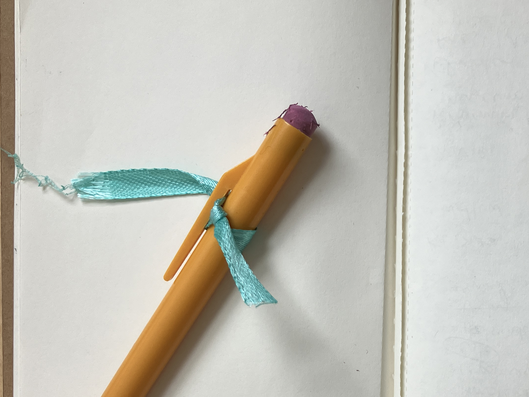
How useful can AI be at this present moment to generate assignments or instructions to teach and train people to live more playful, creative and ethical lives? In this artistic research, I try to put aside fears of a dystopian future in which runaway AI assumes control over humanity, and suspend them long enough to play with the idea of reversing the usual dynamic: what if AI were to instruct us, instead of us instructing AI? What kind of positive outcomes could emerge? I borrow from traditions of instruction art and avant-garde art, and I employ discursive practices that alternate between techno-enthusiastic and techno-skeptical. The AI tool ChatGPT and I hold conversations in which we explore the research question together, and in which I prompt ChatGPT to issue me instructions, then I describe the process and result of executing the instructions.
Unsettled Subject: From Emancipation to Separation
(2026)
Martin Pšenička
This essay is inspired by the contributions to this issue, whose common denominator seems to be the transformation of the nature of authorship and the position of the authorial subject, reflecting the broader theme of the position of the subject in the contemporary world. Some authors, responding to ArteActa’s previous call for submissions, “AI (and) Art: The Poetics of Prompting,” explore the changing conditions of artistic work with AI, while others focus on the interaction between materiality and human perception. All raise urgent questions related to the concept of the subject and the connection between the perceiving mind and the surrounding world. Through a historical reflection of poetics as the art of “prompting,” the text addresses theoretical conceptualization of the subject, in which emancipation at the level of the perceiver plays an increasingly important role. With the advent of AI as a “separate intellect” (Agamben 2025), the emancipation and transformation of (creative) subject raises questions stemming from today's paradox, in which all important and necessary emancipation efforts seem to be distorted or lead to tendencies that brutally contradict them. In this context, does AI bring about the final stage of the emancipation of the subject, or does this autonomous intellect enable hedonistic ochlos-authorship? Without reviving the laments of the past, the essay attempts to point out the fragility and uncertainty of the subject facing unprecedented pressure.
how to strike roots into the void – a trapeze artists view on artistic processes as permacultural growing
(2026)
Carmen Raffaela Küster
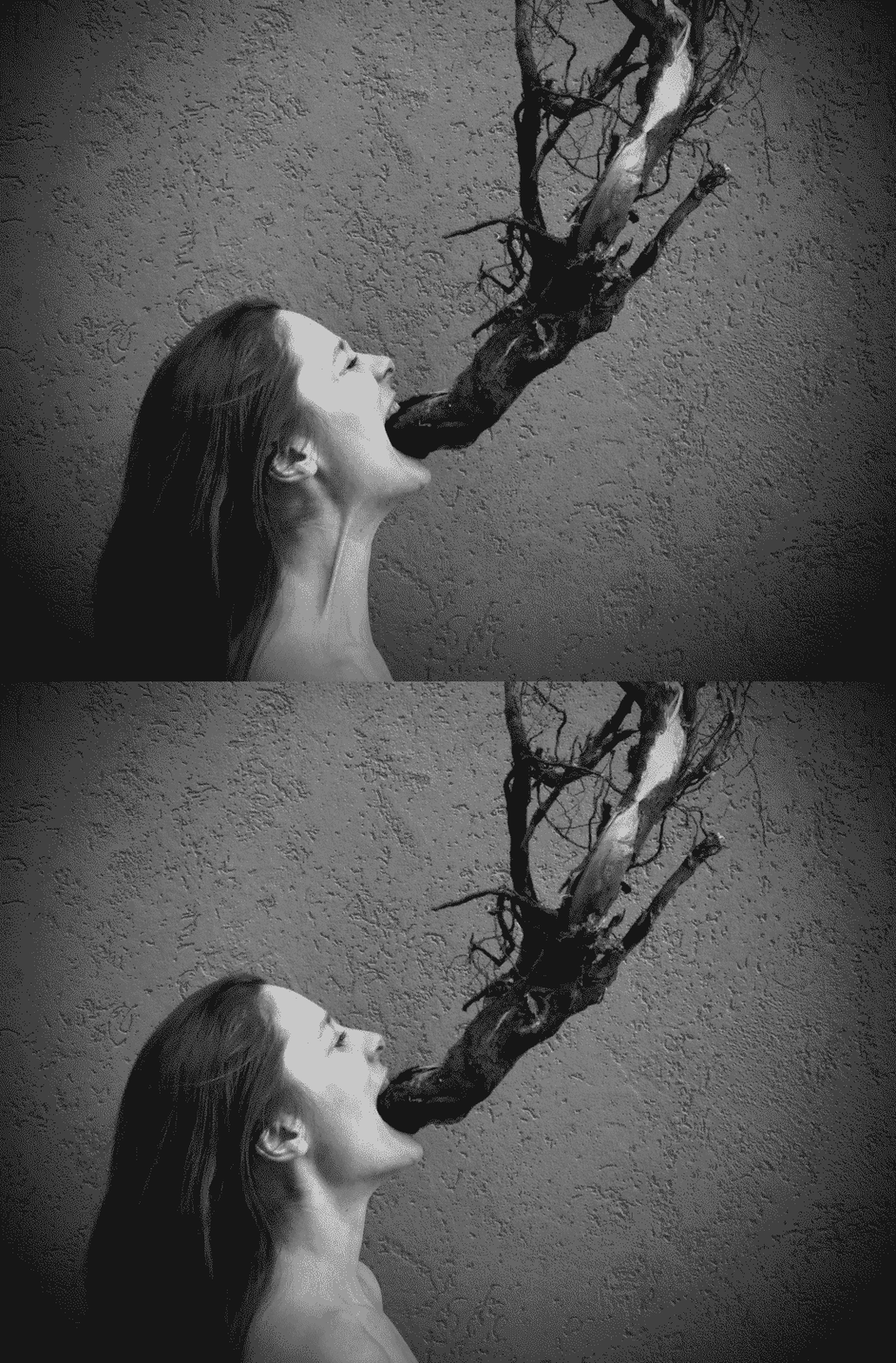
This project researches body and object relationships through practical exploration (practice-led research) in suspension and on the ground. It illuminates connected thoughts linked to posthuman philosophy, permaculture, physical movement and contemporary circus.
Our perception of the world is getting more global and connected, but we have not realised yet the full complexity of all the interdependencies and interplays. In fact it is more than questionable whether this might be graspable for any human to its full extend at all…
The state of being ‘in suspension’ is taken as an analogy for the times we live in – life itself. In a world in which pop-stars sing ‘I have no roots’ (Merton, 2016), mass-migration makes people leave their homes involuntarily and others choose nomadic livestyles that leave them only loosely connected with a geographical place and a single culture. But at the same time, we are always tightly connected (digitally) with ‘the whole world’.
'How to strike roots into the void?' is the essential question of this interdisciplinary research, which has its roots deep 'down' in aerial acrobatic movement. How could this rooting be possible at all? And in which ways? – referring to the question of quality: 'HOW' can we in these times as human being strike out our own roots? Who and what can keep us grounded? To whom or what are we reaching out to search for connection? What nourishes us? And where to hold on to, if the substrate is emptiness – the Void – the uncertainty of life itself?