The Research Catalogue (RC) is a non-commercial, collaboration and publishing platform for artistic research provided by the
Society for Artistic Research. The RC is free to use for artists and
researchers. It
serves also as a backbone for teaching purposes, student assessment, peer review workflows and research funding administration. It strives to be
an open space for experimentation and exchange.
recent activities <>
MY PUBLIC STAGE
(2026)
Ioannis Karounis
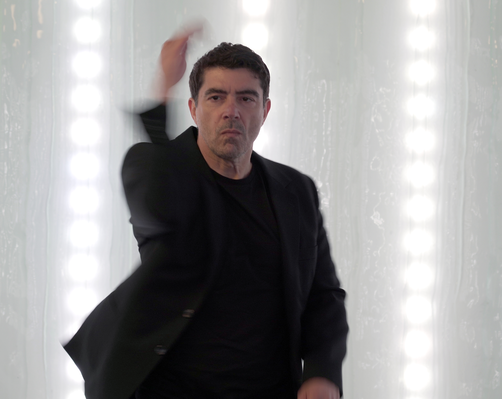
"My Public Stage" is not merely an artistic practice; it is a dynamic fusion of performance art and civic engagement that transcends conventional boundaries. At its core, this practice navigates the intricate relationship between the artist and the public sphere, offering an unconventional perspective on how art can reshape our understanding of the world.
The essential aspect of this artistic journey lies in the intentional placement of artistic interventions and performances within public spaces, where the encounter with viewers is not a predetermined spectacle but a meeting. This deliberate approach seeks to dissolve the traditional separation between the artist and the individual, fostering a unique connection that is spontaneous and genuine.
I view public space as not only a material but also a social environment that is produced, reshaped and restructured by the citizens through their experiences, their intentions for action and the relations they develop in it. My project draws on Lefebvre’s (2019) approach to urban public space not as a neutral container of social life, but as a fluid entity, both constructed and produced by social practices. Lefebvre’s approach confirms and expands my view that public space is not fixed, yet it requires a conscious effort to intervene in its production.
The philosophy driving "My Public Stage" aligns with the concept of civic engagement. By presenting long durational performances in the heart of everyday life, the artist consciously assumes the role of a creator, using performance art as a medium to unveil the interconnected elements that bridge art with life. This philosophy echoes the sentiment of Joseph Beuys, who believed that everyone is an artist, actively sculpting the intricate sculpture we call life.
In embracing the public sphere as its canvas, this practice transcends the conventional boundaries of art and daily reality. It becomes a catalyst for a different perspective on how individuals perceive and engage with their surroundings. The transformative power of performance art is harnessed to reveal the latent artistic potential within each person, emphasizing the symbiotic relationship between art and life.
Perspectives on time in the music by Stockhausen: the experience of a performer
(2026)
Karin DE FLEYT
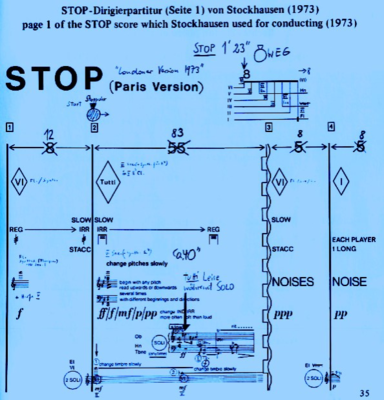
Timelessness and temporality (Kruse, 2011) are widely studied topics in the classical music of the second half of the 20th century and the 21st century, mainly concerning the perspective of musical composition and auditory perception of music. But what is the perspective of temporal layeredness in the performer’s experience? This quote offers a starting point (Noble, 2018): “music whose temporal organisation optimises human information processing and embodiment expresses human time, and music whose temporal organisation subverts or exceeds human information processing and embodiment points outside of human time, to timelessness .”
Specialized in the repertoire of Karlheinz Stockhausen, I want to investigate the role of temporality in music from the perspective of a performer. I will delve into the richness of different layers of temporal awareness in an artistic experience through experiential, embodied, and sensorial knowledge, using different temporal compositions by Stockhausen as case studies: HARMONIEN (2006) for flute solo,, Xi (1986) for flute solo and STOP (1969) for ensemble.
Filming Marlowe's Faustus: an artistic research project
(2026)
Jed Wentz
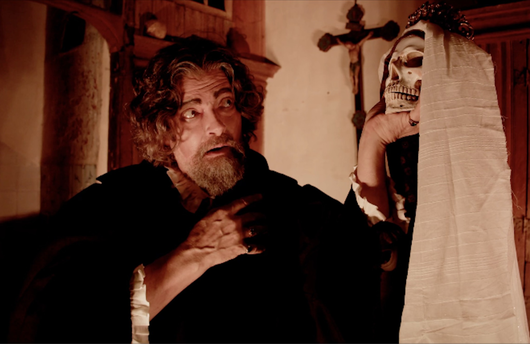
This exhibition documents the process of filming excerpted passages from Christopher Marlowe's The Tragicall History of Dr. Faustus as a series of monologues and tableaux. The resulting film, Scene's from the Tragicall History of D. Faustus, is here uploaded in its entirety, accompanied by supplementary materials related to its creation.
recent publications <>
Text as Material: ASCII and Unicode Pattern Systems
(2026)
Rozita Fogelman
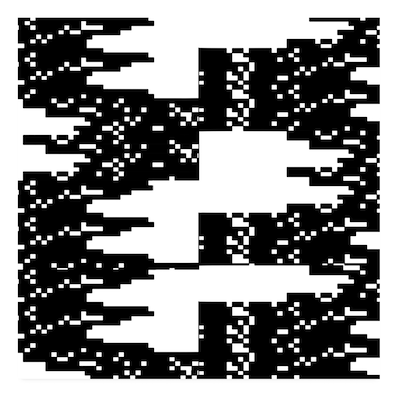
This exposition presents a practice-based research investigation into pattern formation using ASCII and Unicode character systems as primary visual material. Working exclusively within live text environments, the project explores how complex visual and architectural structures emerge from rule-based constraints, repetition, and minimal computational resources. Treating text not as language but as material, the work examines generative logic, duration, and modularity as foundations for sustainable, post-material visual research.
Amazing Patterns ▓█▋◣◣◢◢▋█▓
(2026)
Rozita Sophia Fogelman

Amazing Patterns presents a practice-based investigation into pattern formation using ASCII and Unicode character systems as generative material. Developed within the broader research context of the ASCII Digital Design Museum (ADDM), founded in 2010, the project operates exclusively in live digital text environments under minimal computational constraints.
Treating text not as language but as material, the exposition examines how repetition, variation, and rule-based operations generate complex visual structures from simple symbolic elements. Through sustained, character-by-character construction, the works demonstrate scalability and structural coherence across graphic, textile, and architectural references.
Developed through human-authored, rule-based visual systems prior to contemporary AI image-generation tools, the project positions symbolic computing as a methodological precedent and sustainable exhibition model, emphasizing accessibility, durability, and long-term cultural preservation within web-native systems.
Topographies of the obsolete
(2026)
Anne-Helen Mydland
Topographies of the Obsolete is an artistic research project conceived in 2012 by
University of Bergen Professors Neil Brownsword and Anne Helen Mydland,
in collaboration with six European HEI’s and the British
Ceramics Biennial.
Emerging through two phases (2012-15; 2015-2020) it has to date engaged
ninety-seven interdisciplinary artists, scholars, cultural commentators and
students from thirteen countries. It has transformed participants’ practices, with
works originating out of the initial research being celebrated on an international
platform. Topographies of the Obsolete has received funding from a variety
of
institutions, alongside its core support from the Norwegian Artistic Research
Programme (2013-15 & 2015-17), whose peer review system (2015)
rated it
as ‘exemplary… strengthening artistic research and its scope beyond potential
communities of practitioners/researchers’. The project explores the landscape and associated histories of post-industry,
with an initial emphasis on Stoke-on-Trent, a world-renowned ceramics capital that bears evidence of fluctuations in global fortunes.