The Research Catalogue (RC) is a non-commercial, collaboration and publishing platform for artistic research provided by the
Society for Artistic Research. The RC is free to use for artists and
researchers. It
serves also as a backbone for teaching purposes, student assessment, peer review workflows and research funding administration. It strives to be
an open space for experimentation and exchange.
recent activities >
Performatorium. Research and Documentation
(2026)
Performatorium
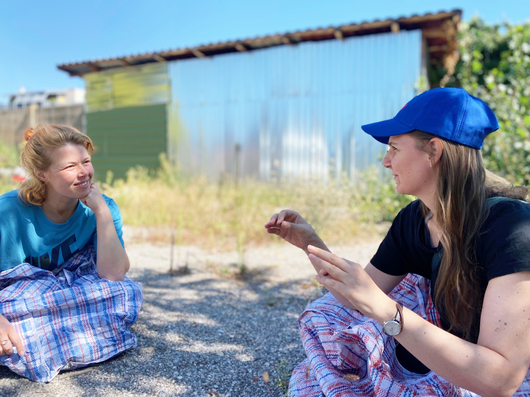
PERFORMATORIUM is an artist-researcher duo (Olivia Jaques/Marlies Surtmann) as well as a laboratory for practice-oriented research with and through artistic means. Jaques/Surtmann have been working together since 2012: As part of the artist-curator collective Friday Exit (2012-2016), they experimented with various exhibition and discursive formats, ran a book club and founded Performatorium in 2017. One focus of the Performatorium is the interconnectedness of the local performance landscape in Vienna. Up to 2020, it offered space for joint experimentation and exchange as an independent, queer*feminist platform for performance. Currently the Performatorium explores the artistic realm as a laboratory by developing artistic performative research methods, activating and updating past performances.
Practices for the future / an Artogrphic approach
(2026)
Sebastian Ruiz Bartilson
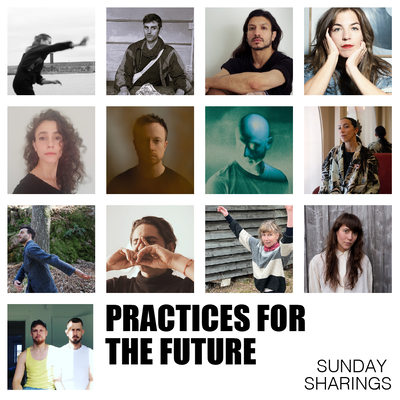
Task submission for course Dokumentation, reflektion och kritisk granskning / Documentation, Reflection and Critical Review
Application of Artographic methods towards own and/ or others dance practice.
Project "Practices for the future"
The Loot
(2026)
Zoe Panagiota (aka Betty) Nigianni
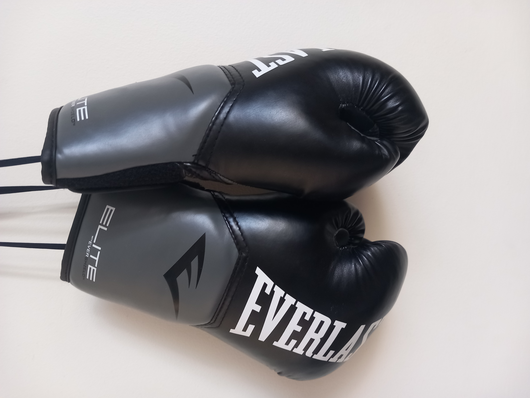
Islington studio flat 4, at 14 Barnsbury Road, London, 2022, privately rented. Interior design and styling, as art installation. Looted, 2024. Investigatory research with artworks, 2023-24. Interactive research blog. The exposition aims to highlight the role of women within an interwoven narrative about a complex and international criminal case.
https://en.wikipedia.org/wiki/Looting
https://en.wikipedia.org/wiki/Loot_(magazine)
My personal belongings were still at the property for two months, after I left on 27 March 2024 and was asked to collect them by 3 or 4 April from Woolwich. After I left, the landlords moved in two or three under aged, who I have never met, so that they pretend to be my daughters. Subsequently, they must have been 'removing' them one by one over the last few months and until October 2024.
The company behind 14 Barnsbury Road was deemed illegal through the courts, on 22 April, 2024, shortly after I was forced to leave at the end of March. The maintenance employed many Polish citizens, all dressed in black with black caps, adopting the XRW supporters' fashion code. The household of tenants was mixed and multicultural, but mainly British natives, with the exception of a couple from Hong-Kong, an American citizen, and myself, a naturalised British citizen, originally from Greece.
Twenty-two (22) and twenty-three (23) photographs, including two (2) plus one (1) of myself: NOT a missing person, from the 2022-2023 period in the eventually looted, in spring 2024, Islington studio. Twenty-five (25) missing persons for twenty-five (25) non-EU and EU fake passports with my family's Greek surname; plus one (1) that might also be connected with a missing Greek teenager, therefore twenty-six (26). Two (2) more missing persons for two (2) more fake passports without my family's surname: an Italian and a Romanian name.
Two (2), plus one (1) targeted cultural producers: the anti-fascist Greek musician, Pavlos Fyssas, aka Killah P. (domestic); the Belgian filmmaker of Jewish origins, Chantal Akerman (global), who lived and worked in France, as well as the US, and whose personal details, specifically her life insurance policy and her medical file, got stolen in connection with the case, can be added to the toll of two (2) deceased. My personal details, name known as and artistic name, as well as numbers connected to my personal details, were stolen, too, while I (post-global) was targeted as a cultural producer, an artist and former academic. Was I going to be the third victim?
Golden Dawn were originally pagans, drawing from the ancient Greek mythology and ritualistic practices, including human sacrifice.
The visual imagery and the art included in the photographs is influenced by the marketing and advertising industry; I brushed shoulders briefly with students in the creative industries teaching at the Winchester School of Art. I used this an ironic commentary on Golden Dawn trying unsuccessfully to create a brand through propaganda, not political marketing.
The art world has been traditionally male-dominated. This has not changed dramatically in contemporary art. Female artists have sometimes adopted male attitudes, or personas, to break into the art scene; see Sarah Lucas and Tracey Emin from the YBA movement. I hold the view that art is not gendered, that there is no art for women or so-called women's art. Good art transcends such categories, tapping into more universal experiences. Saying this, I would like to quote Nancy Spero, who doesn't crudely distinguish between male and female art, as follows:"What if the default gender for 'artist' were female? What if, when we looked at a work by a woman, we said to ourselves, "That is art," and when we looked at a work by a man, we automatically identified it in our minds as 'men's art'?"
In 1999, I wrote a long essay about the architectural uncanny, which I submitted as my graduation thesis for my first MA in architectural theory. I called it "Space as a 'Bad' Object: A criminal investigation on the notion of space". I got inspiration from detective novels and real-life crime stories. The long essay was about the role of architectural space in crime. It was unsupervised until submission: I received a distinction by a Bartlett staff member. I took the digital photographs in conceptual adherence with that essay.
I was a postgraduate philosophy student 9/2017-11/2019 at the University of Amsterdam, Netherlands.
In this exposition, I include new photographs from a series of digital photography called "Forensics", taken with my mobile phone, after I was forced to leave the Islington property I was renting, on 27 March 2024. I gave the photography series that name, because it has served the purpose of investigating, recording and tracking a crime, for which architectural space, such as private rentals, has been used.
For Chris, my former neighbour, who was suddenly transferred by his employer, from London, where his daughter lives, to somewhere outside of London; and for Lawrence, a second generation immigrant from Nigeria, whose temporary post was prematurely terminated, though he was planning to return to his legal studies. And for Ali. And for Oliver, also my former neighbour. In memory of Howard, also a tenant at Bellview, and former neighbour. To all those who don't just "play" the cultural and racial diversity clause; they don't just rely on identitarian politics, because the class problem has not been resolved for them, either; but also because generalising on identity (for instance religion, race, gender) is an unsophisticated way of preventing strategic and/or tactical alliances, necessary for protecting the rights of minorities or other underprivileged groups and populations. Saying this, the UK must stand up against racism, especially against people of African descent. Special thanks to two white British men, who worked in France ("Fiennes") and Spain ("Clooney").
A Nigerian was among the Golden Dawn victims of assassination in Greece.
I was listening frequently to Massive Attack, a British trip-hop band, when I was living in Islington.
Sophie Calle is a French writer and photographer, working on themes of identity, intimacy and everyday existence. Her work is partly inspired by the detective fiction genre. She wrote an art book, to accompany some of her photography, called "Double Game", inspired by her written correspondence with the fiction writer Paul Auster.
recent publications <>
A Sonic Counter-Cartography of Eastern White Pines
(2026)
Danny Clarke
A Sonic Counter-Cartography of Eastern White Pines approaches listening as a spatial, relational, and political condition. Through field recording, biosonification, and generative soundscape composition, the project listens with Eastern White Pines across the Northeastern United States, cultivating immersive listening as an emergent archival practice. Sonic encounters register entanglements of Indigenous ecological knowledge, colonial extraction, enslavement, and ongoing climate crisis. Rather than mapping territory, the work composes counter-cartographies of resonance, latency, and loss. Beyond listening as perception, sound operates as situated knowing – reorienting how place and memory are held, and how responsibility is sensed.
Navigating the field of Despair
(2026)
Jonas Meškauskas
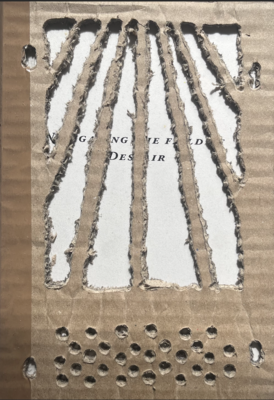
This thesis reflects on a condition in which expectation no longer sustains meaning, but produces obstacles of exhaustion, paralysis, and disorientation. Admitting that this despair is difficult not only to manage ethically, but even to grasp conceptually, attention can shift to a peculiar kind of exploration. The issue of this thesis is not so much with relentless despair itself, but the way desire moves within it. The concern here is what thresholds are passed, how desire drifts, reaches satisfaction and still keeps perpetuating.
Driven by curiosity, this investigation responds to a pervasive sense of doom not in order to solve this riddle, but to cultivate an awareness of despair’s persistent circulation within the contemporary life of uncertainty. An attentiveness to despair in this thesis is mapped by constructing a field of arbitrary categories and obscure references, which, in a playful, but critical way, reveals a loose framework of conditions, under which desire and despair interact and leave artefacts as residual traces of this contemplation.
Here is an attempt to map the field of despair – the anatomy of despair’s tormenting abstractions, the thresholds where meaning shatters, and the different trajectories of desire, action, and evidence, that emerge in response. The driving question here is how, in this context of emptiness of meaning, traces of which haunt the surface, can these responses still be meaningful? How are ethical considerations reflected in artistic practices? How does desire shift when a relation to despair is expressed performatively or merely displayed? How might a navigation of this odd terrain restore dignity again?
The aim here is neither resolution, nor dismissal, but an open-ended destabilisation, within the context of contemporary culture. More importantly, the effort here is to clarify the moral dimension across artistic practices that deal with despair. This attempt can contribute to an understanding of value, an appreciation of ritual and community, and the possibility of meaning emerging from within what could otherwise appear as a paralysing pathology. In the end, this is an offering of a method to confront uncertainty with care and reverence.
Division Dialogues
(2026)
Erik Aberg
The Documented Artistic Research Project (Doctoral Thesis) Division Dialogues: On the Components and Practice of Juggling explores a methodology emerging from juggling practice. The point of departure is the identification and naming of a method common in the field of juggling, termed reduct-construct. The project investigates how this method can be translated across domains: first into sculptural object-making, and subsequently into archival work. In this process, juggling techniques, sculptural components, and historical documents are all approached as materials that can be broken down into elements and recombined into new constellations. The research positions historiography as a creative, generative practice, one in which history becomes a resource for experimentation, artistic inquiry, and the articulation of new perspectives.
Through the research process, we follow how a practice evolves as its underlying sensibilities are identified and extended into artistic domains beyond juggling. The project engages with historical figures and their appearances in newspapers, while also opening onto broader existential questions. In this way, the work demonstrates how artistic practice, when reflected upon and translated across contexts, can generate new forms of knowledge and modes of expression.