The Research Catalogue (RC) is a non-commercial, collaboration and publishing platform for artistic research provided by the
Society for Artistic Research. The RC is free to use for artists and
researchers. It
serves also as a backbone for teaching purposes, student assessment, peer review workflows and research funding administration. It strives to be
an open space for experimentation and exchange.
recent activities >
Works for solo violin and viola. Exploring long-term collaboration with David Matthews
(2026)
Peter Sheppard Skærved
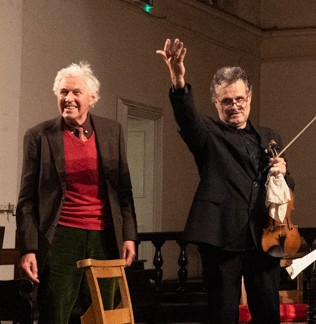
I have collaborated with the composer David Matthews for over thirty years.
This exposition focuses on the ideas and insights that result from our long-term work together on music for violin (and viola alone. Matthews's output in this arena is prolific, and 2/3rds of his solo works have been written for me.
Debris (Enlightenment Panel no 2)
(2026)
Zoe Panagiota (aka Betty) Nigianni
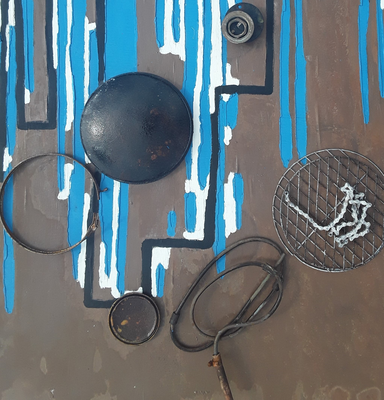
Sculpted and painted wood, combined with treated rusty objects. Duct tape with boat paint models for metal sheet sculptures, 2020. Digital drawings, 2021, 2023. Dutch steel sailing boat part-restoration and renovation, Amsterdam (with Sean A. Hladkyj), 2019 until summer 2020.
I exposed relief and improvised sculptures made with industrial paints, as well as found objects, to weather conditions, including heavy rain and wind, over a few months on a floating timber raft. Working with the changes the weather was causing to the ad hoc studio, I made changes until the painting was finished, photographed, then dumped. Someone collected the relief. I applied the colours from those available in a symbolic manner, abstracting the view of a ghetto in a large city. The objects stand for the landmarks.
The pieces would comprise of the scenography for a theatre performance, informed by my conversations with a theatre lighting technician. The performance would also include a donation event of the art objects. See external link for the theatre play, based on the tradition of the philosophical dialogue and employing the idea of performing philosophy to make it accessible to a wider audience.
Political asylum has been traditionally offered to people who flee from their countries of origin and citizenship, because of violations of their dignity, which is a human right, and other basic human rights, such as safety and liberty, due to their political beliefs and related activities, if any. Currently, seven human rights of mine, five basic, have been infringed in the United Kingdom, where I have been a citizen since 2011; the origin is my native Greece. Political asylum is only offered to people, who are non-citizens of the country where asylum is sought from. At the same time, political asylum has become harder to offer, due to the global nature of persecution of whoever is perceived as a dissident by authoritarians.
Since 2020, Forza Nuova, the Italian affiliate of the Greek Golden Dawn, with contacts in the Middle East, specifically Hezbollah, has participated in the organised international criminal case, of which I have been the target, originating from my native Greece, "accelerating" in the Netherlands and the UK in 2020, Covid-19. This happened with the theft of my personal details, specifically my Greek driver's license number, by Italians, in Amsterdam, in the winter of 2020. My number was used on four fake Italian driver's licenses,in my name known as (aka), for criminal activity in the UK. My name known as (aka) was also used on four fake Italian passports for fictitious female Albanian citizens, succeeding two fake Albanian and a fake Kosovo passports for three of the four Greek teenage users, with different details than the fake Italian ones, which three of the four teenagers had: the youngest one, also had another fake Albanian, preceding the fake Kosovo, again with different details than the other fakes she had. A deceased Belgian filmmaker's, Chantal Akerman's, life and health insurance was falsified by the use of the two fake Albanian passports in 2018 and extended with the fake Kosovo, for the youngest, in 2019.
Forza Nuova is suspected of being connected to two abductions: one domestic of an Italian citizen circa 2020 and one in Holland of a Spanish citizen circa 2022.
Notably, Roberto Fiore, Forza Nuova's neo-fascist leader, inherited briefly Alessandra Mussolini's post in the EU parliament. All the more so, after mediation with the Albanian government, the Italian government settled in the autumn of 2024 one remaining fake Italian passport for a fictitious Albanian citizen, probably in connection with Golden Dawn, who had their own three MPs in the EU parliament. Rumours have it that Fiore was once upon a time an MI6 agent. It is confirmed that he has ties with the British National Party (BNP), the British XRW component.
Italian Jews, including Greco-Italian Jews, were persecuted by the Catholics and almost exterminated in the late nineteenth century. My great grandfather, from my father's side, with the first name Gianni, went to my native Greece, from the North of Italy, around that time, He became Hellenicised and adopted the Greek Orthodox religion. We don't know his surname.
The Jews is the archetypical diasporic population historically speaking.
The Holocaust and the Slavery past are the black marks of modern historical times.
Drawing on the philosophical notion of impossible objects, the works attempted an indirect postcolonial critique: a suggestion for alternative, autonomous and communitarian lifestyles; and a performative metaphor for global refugees of all kinds. At the time, in autumn 2019, I had attended an environmental protest in Amsterdam that was generally peaceful.
Investigatory research with artworks, some of it carried out in Amsterdam, the Netherlands, where I was a philosophy student, from 2017 until late 2019, and remained until the beginning of autumn 2020. I did not have student insurance, as it was obligatory, because I was covered by the NHS through EHIC (European Community coverage), while the UK was still in the EU. I didn't have travel insurance either. Dutch travel insurance, under the reference number E111, was opened by unknowns on my behalf in the summer of 2020, to cover the expenses of routine women's healthcare and family planning tests, but was closed as fraudulent after I reported to the Dutch fraud authority that I didn't open it myself; neither I had any knowledge about who might have done that.
The exposition also showcases and juxtaposes a performative video, drawings and other visual art, by "Mohammed", aka 'Onzedouze', an investigator, who turned his hand to art, in order to record and communicate, in an improvised, codified , but still artistic manner, what was of interest to him with regards to a relevant investigation.
The title "Enlightenment Panel" comes from Peter Sloterdijk's 'Critique of Cynical Reason', published in 1983, which critically discusses philosophical and popular cynicism.
See exposition, also in connection with expositions under 'Art and Activism Exposed as Research Blog'.
XRW (Implicature)
(2026)
Zoe Panagiota (aka Betty) Nigianni
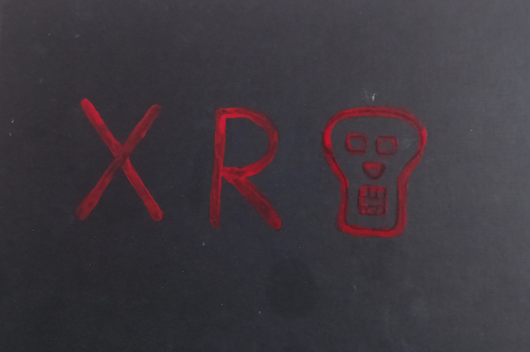
50 A3 drawings black and coloured markers, including:
3 A3 collages on paper with newspaper cutouts and printed photos.
12 A4 drawings on paper with coloured markers, glued on A3 paper + 1 A3 with black ballpoint pen and markers, glued on A3 paper.
13 A3 drawings on paper with black marker, and red, pale blue, gold, pink and orange markers +1 A3 two-sided.
17 A3 drawings on paper with coloured markers.
1 drawing on sketchbook cover with red nail polish.
1 text drawing on sketchbook cover inside.
1 drawing on sketchbook cover back inside with black, orange and gold markers.
22 A4 drawings with ballpoint pen.
62 pocket sketchbook black marker and ballpoint pen drawings.
Some of the above is preparatory work for 4 large prints and 13 paintings. The 12 A4 glued on A3 are preparatory work for a collage on panel.
I made the art between 2023-2024, from the perspective of the observer. Most of the research material came out of crime and fraud reports. I started writing the blog afterwards, since the summer of 2024.
I adopted the visual vocabulary of the graphic novel, which I partly studied and read a lot about, looking at different graphic artists' work, when I was attending classes at the University of Malmo, Sweden, in 2012, to familiarise myself with elements of game design. Much of this work is, amongst other, about children: how they love, amongst other. I wanted to emphasise that element, by intentionally applying stylistic elements from children's drawings, in a naive and loose architectural composition, using heavily the black marker and stick figures. Adopting this visual approach, I also wanted to evoke a comically sharp, but intimate twist, as commentary, in the British tradition of political satire, to the otherwise dark subject matter. Finally, this artistic style refers to the populist character of actors.
The text is written like trip-hop songs: two of the pseudonyms I gave are the artistic names of musicians of colour from the British band "Massive Attack", formed in Bristol. Otherwise, it is loosely structured in a manner inspired by television series. I used heavily popular culture signifiers, names of fictional characters from film, television, music and painting, as reference to actual individuals. Parts of the analysis is inspired by Saul Kripke's interpretation of Wittgenstein's example of mathematical calculation. I used plenty of popular and less popular literary and philosophical references, for the visual art and in the writing.
Saul Aaron Kripke was the inventor of the possible worlds philosophical hypothesis, which was seminal for philosophers working in the area of contemporary analytic metaphysics, including the theory of counterparts and the theory of names. He died in 2022. Lauren Berlant was a cultural theorist and gender studies scholar. She died in 2021. The exposition displays loosely and in lay terms vocabulary as rhetorical devices from analytic metaphysics, as well as gender and romance studies; for instance, I use the word "unactualised" to refer to individuals, who are real and concrete, who exist independently of my mind, however they were not "actualised" in my so-called personal life and dating practices: for that, I would have to select them, in order for them to be "instantiated" in my dating.
The exposition is underpinned by an underlying neo-Marxist interpretation that, in my view, is relevant not just to economists and political philosophers, but also to people working in different sectors of our modern economies of advanced capitalism, such as banking and cybersecurity.
In the style of art, as painting, I was inspired by Jean-Michel Basquiat's drawings and paintings, which are laden with input from popular media sources, like jazz music and television, recorded in an automatic and naive drawing manner, turned into abstracted paintings.
For "Panos" ('Ramadan', 'Julien', "Mr X"), Filip ('Philip'), and Brandon ('Magna') (and Nick) - August, September, and October 2024 (March 1996). For "Daddy G" ('Isaac'), 'Eric' ("Her Man"), 'Prudence' ("'Sharon''s Beau", or "Her Man's alter-ego"), 'Moussa', 'Gaetan'; Black 'Humbert Humbert' meme (and friend), 'Miloud'; Mohammed' ('Onzedouze'), 'Hermando', 'Nesseem' and 'Didi' - December 2024, January 2025, May, June, July, August, September, as well as November to December 2025; again January 2026, with 'Prudence' in Paris. Seven men of colour and seven white men, who were also targeted, directly and indirectly. Who are not politicians, except for a current one and a former one, but are doing something political, so they must take good care of what they do.
All my drawings were stolen in Paris and Brussels, in 2025.
See also exposition "The Loot", under 'Art and Activism Exposed as Research Blog'.
recent publications <>
Why journalists need a carrier bag, not a spear
(2026)
Tanja K. Hess
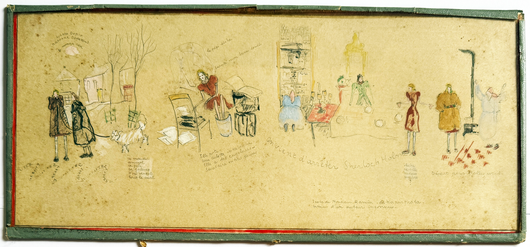
Journalistic storytelling should move away from the hero narrative. Instead, drawing on Ursula K. Le Guin’s Carrier Bag Theory, it should adopt a “carrier-bag” perspective: to gather, carry, and connect—collecting attentively, bringing home what matters, and linking insights through pencil-based drawing. Drawing becomes a journalistic method for deepened research. Through the nouvelle histoire (Annales School, longue durée) and the sculptural contrast between Rodin (monumental condensation) and Medardo Rosso (fragile appearance), the text shows how attention to everyday life, materiality, and in-between spaces generated new forms of relevance and helped initiate social shifts. Drawing is proposed as a research practice that makes complexity visible, marks uncertainty, and enables more peaceful, context-rich modes of storytelling in newsrooms and teaching.
Non è il gelato ad essere consumato ma chi lo vende.
(2026)
Alessandra Debernardi
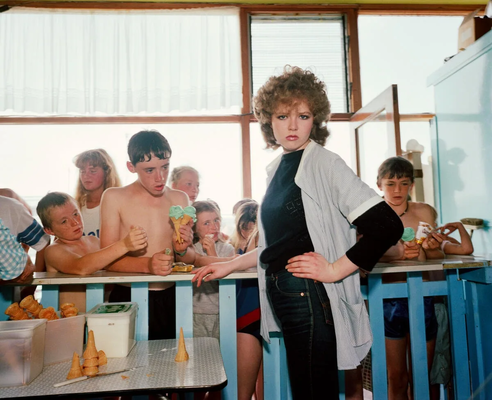
Questa esposizione fa parte di un progetto di ricerca artistica più ampio, articolato in diverse declinazioni.
Il focus presentato si concentra su un’indagine specifica della violenza attraverso il dispositivo dell’auto-conferenza, intesa come pratica performativa e riflessiva.
La ricerca prende avvio dalle conferenze autofinzionali di Sergio Blanco, in particolare dalla sua elaborazione della violenza come costruzione narrativa, e si sviluppa attraverso la rielaborazione di un’esperienza personale di violenza subita. In questo contesto, l’autofinzione diventa uno strumento metodologico capace di mettere in relazione l’esperienza vissuta, il discorso teorico e la rappresentazione.
L’auto-conferenza viene quindi intesa come una vera e propria metodologia di ricerca artistica: uno spazio in cui l’esperienza personale si intreccia con riferimenti teorici e visivi, generando una riflessione critica sulla rappresentazione della violenza e sulle possibilità del racconto di sé come pratica di conoscenza. L’elemento autobiografico, sempre in bilico tra attendibilità e finzione, diventa così il punto di partenza per una riflessione che supera l’io dell’autore e si apre a una dimensione collettiva, coinvolgendo lettori e spettatori.
Paths of Artistic Research
(2026)
Silvia Diveky, Monika Šimková
Interviews about where artistic research is heading
The work Paths of artistic research is a collection of interviews with artistic researchers - Andrea Buršová, assistant professor at the Nika Brettschneiderová Dramatic Acting Department, Faculty of Drama, JAMU, Jiří Honzírek, director, manager of the Feste Theatre and PhD student at the Theatre Faculty, JAMU, Barbora Klímová, head of the Studio of Environmental Design at the FFA BUT, Lenka Klodová, head of the Studio of Body Design at the FFA BUT, Lucia Repašská, researcher at the Cabinet for Theatre and Drama Research, Theatre Faculty, JAMU, Hana Slavíková, head of the Studio of Radio and Television Dramaturgy and Scriptwriting, Theatre Faculty, JAMU, Pavel Sterec, artist and former head of the Intermedia Studio at the FFA, BUT, and Lenka Veselová, researcher at the Department of Theory and History of Art at the FFA, BUT and PhD student at the FFA, BUT. These are artists who have been associated with art colleges in Brno, specifically with the Faculty of Fine Arts of the BUT and the Theatre Faculty of the JAMU. Through interviews with the artists, the reader will learn under what circumstances they began to engage in artistic research, how they perceive it, what meanings they attribute to it and the purpose it serves for them. The selected group of artists is very diverse and their creative and research strategies are different, as are the purposes for which they use artistic research. The work does not aim to provide an exhaustive overview of the methods used in artistic research, but it does aim to show that there are many approaches to artistic research and to present the paths that have brought particular artists to artistic research.